The Gospel in Italy. An Interview on The Gospel Coalition website

November 25th, 2015

by Ivan Mesa

The Gospel in Italy

Home of the pizza, battery, piano, espesso machine, barometer, typewriter, violin, and MP3, Italy is replete with interesting cultural history.

This peninsular country, nestled in the heart of the Mediterranean Sea, became a nation-state in 1861 (with the establishment of a monarchy) until the Fascist dictatorship of Benito Mussolini during WWII. Since 1946 Italy has been a democratic republic and today boasts the fourth-largest national economy in Europe.

Almost twice the size of Georgia and slightly larger than Arizona, Italy has a population of 61 million—just a little less than France and the United Kingdom. Two sovereign nations exist within the Italy itself, including the Vatican. It should come as no surprise, then, that upwards 80 percent of its population identifies as Roman Catholic with a meager 1 percent identifying as evangelical.

Continuing our series highlighting how the gospel is at work in various countries, I reached out to Leonardo de Chirico, pastor of Breccia di Roma church in Rome and lecturer of historical theology at the Istituto di Formazione Evangelica e Documentazione (IFED). A keen observer of the Roman Catholic Church, Chirico discusses the state of the church in Italy today, what it’s like to be an evangelical in Rome, recent Vatican intrigue, and more.


In a hundred words or less, how would you describe the state of church in Italy?

As the Protestant Reformation was suffocated in the 16th century by a powerful Roman Catholic church, the evangelical community in Italy has always been a tiny persecuted minority until the second half of the 20th century. Having learned to survive, churches are made of solid believers who nonetheless tend to be inward-focused and suspicious of others. However, these difficult conditions didn’t prevent the gospel from spreading, especially in the southern regions of the country. Evangelicals represent roughly 1 percent of Italy’s 61 million people. So the work ahead of us is massive.

What most encourages you about the evangelical church in your country?

The faithful evangelical witness of past generations in difficult circumstances is inspiring. The gradual growth of cooperative efforts—for instance, in advocating for religious freedom or mercy ministries—is also encouraging. There are more solid books being translated into Italian (e.g., authors like Don Carson, Tim Keller, John Piper, John MacArthur, Mark Dever), and conferences and training initiatives are available for the Italian public. Recently the Dictionary of Evangelical Theology, a 900-page volume with more than 600 entries, was edited by Italian theologians and had to be reprinted—something unthinkable even a few years ago. There are 120 students following a non-residential five-year course in Reformed theology at the Istituto di Formazione Evangelica e Documentazione (IFED); this is also encouraging.

In the past, Italian theologians have significantly contributed to the cause of the gospel worldwide: I think of Peter Martyr Vermigli (1499–1562), peer to John Calvin and Heinrich Bullinger, whose Loci Communes (Common Places) were standard works for generations of Protestant pastors. I think of Francis Turretin (1623–1687), whose Institutes of Elenctic Theology is a crown of Reformed orthodoxy that served as the theology textbook at old Princeton Seminary. So while there’s still much to be translated, I’m convinced of the need for Italians themselves to write and develop contextually appropriate resources.

There’s also a growing desire to see a shift from the survival mentality of the past to a missional mindset for the glory of God and the good of the nation. Without negating our struggles and problems, there is a sense of a coming momentum for the gospel. Efforts to help the Italian church from abroad have largely tended to either bypass national Italian church leadership or support autonomous individuals. I think we are becoming more credible partners to work with in promoting the gospel in our country.

What are the biggest challenges facing the evangelical church in Italy?

As my senior colleague at IFED Pietro Bolognesi rightly argues, we have three main challenges: (1) identity, (2) unity, and (3) training. In a struggling minority situation, Christian identity has been largely defined not by who we are but by who we are not (e.g., not religiously Roman Catholic, not theologically liberal, not culturally secular). The overall perception has been that evangelicals are a cult. There is a need, then, to better grasp our evangelical identity based on core gospel essentials rather than on subcultural features.

Then there’s unity. Secondary distinctives have produced too much fragmentation. We need to do together what’s biblically possible, knowing that most of the challenges ahead of us (e.g., public witness, church planting, quality training) cannot be faced on a local level alone.

Lastly there’s training. In struggling and small churches, formation haven’t been viewed as a priority. Most leaders are self-taught and self-trained. Cultural engagement is often shallow. The situation won’t improve if leaders don’t emerge who are better equipped for ministry and if we don’t have Christians better prepared for how to be faithful and missional in their vocations.

A few years ago TGC published two pieces by Italian ministers. While one bemoaned the scarcity of spiritual leaders, the other lamented the shortage of Italian exegetes. In one sense, they were calling for the same thing: faithful, qualified, and able ministers of the Word of God. Would you agree with their take? Would you add anything?

They certainly describe a real need. God’s church exists where God’s Word is faithfully preached. We need preachers who aren’t only exegetes but also men of the Word to raise the profile of Christian ministry in the country. We also need churches prepared to move beyond extreme independence and develop the ability to operate in networks. We also need to nurture a vision for gospel impact on the whole country, not just maintenance of our own little tribes. Our dream should be to see God grant a time of biblical reformation that boldly confronts the idolatry of the nation.

For many years you’ve maintained a blog titled the Vatican Files (also appearing on Reformation21) where you write on the Vatican and Roman Catholic issues from an evangelical perspective. How did this begin? And what has the response been over the years?

As a theologian living in Rome I thought one way I could serve and contribute to the efforts of the global church would be to provide ongoing reports and assessments of Roman Catholicism. The allure and appeal of unity with Rome is as enticing as ever. Yet the need is to understand Roman Catholicism as a system governed by spurious principles such as optimistic anthropology, synergistic salvation, abnormal ecclesiology, and ambiguous church-state identity which lies at the heart of the church. The Vatican Files are tools designed to help grasp the theological system binding the whole of Roman Catholicism—and it attempts to go beyond simplistic and superficial understandings of it. I’ve received encouraging feedback from around the world saying the Vatican Files are useful. Today, the contribution that Italian theology can make to the global evangelical family perhaps lies in helping it to frame a biblically robust assessment of Roman Catholicism. More than ever this is at the top of the list of the global evangelical agenda.

Various reports indicate that a conservative dissent has been brewing in the Roman Catholic Church’s hierarchy as Pope Francis has sought, contrary to Roman Catholic doctrine, to grant divorced and remarried Catholics entrance both to the Church and to communion. As an evangelical in Rome, what’s your take?

Pope Francis is working hard to change the overall narrative of the Roman Catholic faith, wanting it to be marked by mercy and inclusivity instead of tradition and rules. He’s pitting the “letter” against the “spirit” of Roman Catholicism, pushing the latter over the former. This explains the concerns of certain traditional quarters about ambiguities in his language, also present in the final document of the recent Synod on the family.

Pope Francis wants to overcome the letter of canon law with a merciful spirit that welcomes all without challeging anyone. This is why he’s so loved by secular people. Everyone feels affirmed and no one feels questioned by what he says. But the biblical good news is that Jesus has come to pay for our sins and calls all persons to repent and believe. If you miss one bit of the gospel, you miss it all. The Pope uses language that resembles the gospel, but the meaning of what he says is far from it.

How can we pray for the evangelical church in Italy?

Please pray for:

  • a growing appreciation for gospel centrality in all we are and do;
  • a stronger sense of being part of the historical and global church of Jesus Christ;
  • a deeper sense of unity based on gospel truth;
  • a new enthusiasm in church planting and evangelism, especially in urban centers;
  • a support of training initiatives that are biblically sound and culturally relevant;
  • a peer-to-peer gospel partnership between the Italian church and the global church wanting to help us; and
  • a renewed gospel-centered engagement of society that addresses the bankruptcy of both religious and secular illusions in the hope God will move powerfully in the country.


115. Rome, the Pope and Gospel Work in Italy. 10 Questions With Leonardo De Chirico

November 18th, 2015

This interview was published in Credo Magazine, volume 5, Issue 4, November 2015, pp. 8-11.

Leonardo De Chirico is the pastor of Breccia di Roma, a church that he helped plant in Rome in 2009. Previously, Leonardo planted and pastored an evangelical church in Ferrara, Italy, from 1997 to 2009. He earned degrees in History (University of Bologna), Theology (ETCW, Bridgend, Wales) and Bioethics (University of Padova). His PhD is from King’s College (London); it was published as Evangelical Theological Perspectives on Post-Vatican II Roman Catholicism. In 2015, he published A Christian Pocket Guide to Papacy (Christian Focus). He is a lecturer of Historical Theology at Istituto di Formazione Evangelica e Documentazione in Padova, Italy. Additionally, Leonardo is the Director of the Reformanda Initiative, which aims to equip evangelical leaders to better understand and engage with Roman Catholicism, and the leader of the Rome Scholars Network (RSN): www.reformandainitiative.org

1. Did you grow up in the Catholic Church? If so, what drew you to become an evangelical Christian?

My family was an ordinary Italian family, nominally Christian and devout to Saint Antony, but with little grasp of basic gospel truths. One day we were visited by a Swiss couple from the local evangelical church that was going door to door. They asked if we were Christians. The answer was “yes, of course.” They further asked if we had ever read the Bible. The answer was “no.” Catholics were not supposed to read the Bible.

They then replied, “How can you be Christian if you don’t read what Christ has done for you?” It was as if a light was switched on in the darkness. It was the beginning of a journey that led my father to become a believer, then the rest of the family followed at different stages of life.

2. What is the main doctrinal divide, in your estimation, between Roman Catholics and Protestants?

In Roman Catholicism the tendency is to idolize the church. The distinction between Creator and creature is blurred by way of conferring to the church what ultimately belongs to the triune God alone. The church is elevated to a position that makes it an idol, stemming out of a non-tragic view of sin, the conviction that in significant ways the church continues the incarnation of Jesus Christ resulting in an abnormally conflated ecclesiology. The great bullet points of the Protestant Reformation, i.e. Scripture alone, Christ alone, grace alone, are all biblical remedies against the idolatrous tendency of a self-referential church, which sadly have been rejected so far.

3. In your ongoing interaction with Roman Catholics in Italy, what approach have you taken and found to be effective when witnessing to them?

Exposing them to Scripture as much as possible and not assuming they already grasp the basics of the gospel. They may know some Christian vocabulary, but it is generally marred, distorted by traditions and deviant cultural baggage. Most Catholics in Italy are of the “pick-and-choose” variety and so they blend unbiblical traditions and secular unbelief. It is also important to show the personal and the communal aspects of the faith in order to embody viable alternatives for their daily lives.

4. You have written a very helpful little book on the papacy. So tell us, what are positive and negative aspects of this new pope Francis?

There is much sentimentalism about Pope Francis. He is a champion of the gospel of “welcoming all” and “showing compassion.” Many secular people, as well as many evangelicals, are fascinated by it. We should ask: What about repentance and faith in Christ alone? What about turning back from idolatry and following Christ wholeheartedly? What about putting the Word of God first? Some of the language of the Pope seems to resemble gospel emphases, yet the substance of it is still heavily sacramental and Marian, leaning towards a liberal form of Catholicism. He is the first Jesuit to become Pope and we should never forget that the Jesuit order was founded to fight against the Protestant Reformation by learning its secrets and using them against it.

5. Let’s address the elephant in the room: Is the Pope the Anti-Christ?

Luther, Calvin, the seventeenth-century Protestant confessions, the Puritans, Wesley, Spurgeon, et al., believed that the papacy (not this or that Pope) is the institution out of which the Anti-Christ will eventually come. I share this broad protestant consensus. The papacy claims christological and pneumatological titles and prerogatives (e.g. vicar of Christ, infallible teacher, supreme head of the church with full, immediate and universal power), coupling them with earthly political power. Remember that Popes are monarchs of a sovereign political state. In the papacy what belongs to God and what belongs to Caesar tragically intermingle. This poisoned mixture is the potential milieu for the Anti-Christ to rise from.

6. You are a pastor of a Reformed Baptist Church in Rome. Is a church like yours extremely rare? How has the culture perceived your congregation?

Evangelicals are 1% of the population in Italy and Rome is no different from the rest of the country. We still struggle with the centuries-long prejudice of evangelicals being perceived as a cult. What makes our church distinct is that it is confessional (holding to the 1689 London Confession of Faith and belonging to a Reformed Baptist association of churches), urban (impacting the cultural, political, media, and academic institutions of the city with the gospel), and missional (living to the glory of God in all vocations and initiatives). Unlike cults, we cherish church history and claim to belong to the catholic (not necessarily Roman Catholic!) church. Unlike cults, the gospel we believe in is for the whole of life. Unlike cults, we encourage constructive and critical cultural engagement. Thankfully, there is a growing number of churches like that.

7. Tell us about this new piece of property your church is purchasing. Why is this so exciting?

Because of the presence of the Vatican, Rome city center has been, until recently, a “heresy free-zone.” Non-Catholic initiatives were not welcomed, if not forbidden. The last property that evangelical churches bought in the central area dates back to 1920. After nearly 100 years we are sending the message that we love the gospel and we love the city. We want to be a gospel community right at the heart of it. Apart from hosting the activities of the church, the property will also function as a theological study center. With IFED (a Reformed theological institute: www.ifeditalia.org) we are providing outstanding theological training to lots of students. In Rome we will act as an outpost of evangelical theology, next to the Jesuit and the Dominican universities which are located around the corner! The space has the potential to become a springboard for gospel work in the city and beyond. For example, the Reformanda Initiative has just been launched (www.reformandainitiative.org). It aims at helping the world-wide evangelical church to relate biblically to Roman Catholicism.

8. If our readers get the chance to visit Rome, what two places must they see?

Evangelical tourists should see the “dark” sides of Rome as far as religious freedom is concerned. For instance, Campo dei Fiori is a beautiful square next to the baroque Piazza Navona where Popes burnt heretics of all types, Protestants included. In the middle of Campo dei Fiori is an impressive bronze statue of Giordano Bruno recalling his execution that happened there in 1600 because he was a “free thinker” in an age and place where total submission to the power of the church was imposed. A number of Evangelical martyrs found the same destiny there.

Another place to visit is Porta Pia where the Italian army entered the city and conquered it in 1870, thus ending the history of the Pontifical state. The Bible in Italian was forbidden in Rome up to 1870. It was through the breach of Porta Pia that the first Bibles printed by the British and Foreign Bible Society were smuggled into the city and freely distributed to the people. The tragic irony of Rome is that she is known as one of the cradles of Christianity, but the reality is that the Bible was a forbidden book for centuries. Generally, no tour guide tells you these stories or shows you these places.

9. Let’s get down to the important stuff: which football team should we be rooting for (that is, “soccer” for our American readers!)?

In Rome there are two top teams: Roma and Lazio. People tend to be very passionate about one or the other or – should I say – one against the other! People stop talking to you if you happen to support the other team. I was not born in Rome, so I am excused to support Torino FC, which is not perceived as a rival to most Romans. In this way, I don’t run the risk of losing a friend for supporting the wrong football team!

10. If I have just one meal in Italy, what authentic dish should I order?

Try “strozzapreti” (literally “priest stranglers”!). It’s a savory pasta dish, like thick and twisted macaroni. It can have various combinations with different tomato-based sauces. In popular culture, Roman Catholic countryside priests were teased because of their voracious appetites and impressive bellies. So this pasta was supposed to “strangle” them because of its thickness. The great Dante used the law of retaliation to punish people in the Inferno. Popular culture made a kind of pasta to punish greedy priests. A tasty reminder that no glutton will inherit the kingdom of God!


Webinar with Leonardo De Chirico: The Theological Vision of Pope Francis

17 Nov 2015, 18:00 (London Time)

Pope Francis seems to be an easy character to come to terms with. Frugal, transparent, down-to-earth, he is one of the most popular public figures around the globe. What about the theological vision that permeates his papacy?

In order to have a glimpse inside of Francis’ spiritual horizon, one needs to take his Jesuit identity into account. In spite of the kind manners of the man, a certain anti-protestant attitude lingers in the Pope’s mind and heart, especially as far as Luther, Calvin and the Puritans are concerned. Although he does not seem pushing a dogmatic outlook of Roman Catholicism as his precedessor, he nonetheless has his own “dogmatic certainties” and they are not what one may expect them to be. The insistence on one’s own conscience and the pervasiveness of God’s grace in it is paramount to approach his overall view of the relationship between God and human life. This explains why so many secular people resonate with what he is saying. They don’t feel challenged but affirmed.

Furthermore, his insistence on “mission” needs to be grasped within the whole of his theological framework. The use of the same word by other Christians does not necessarily imply the same meaning. Mission is the outworking of Francis’ program and fits his own personal interpretation of the papacy. Since catholicity is what Roman Catholicism stems from and look for, Francis’ version of catholicity is perhaps the most significant mark of his papacy.

Date & Time:
17 Nov 2015, 18:00 (London Time)
Sign up here
http://www.foclonline.org/webinar/theological-vision-pope-francis


Leonardo De Chirico is the pastor of Breccia di Roma, a church that he helped plant in Rome in 2009. Previously, Leonardo planted and pastored an evangelical church in Ferrara, Italy, from 1997 to 2009. He earned degrees in History (University of Bologna), Theology (ETCW, Bridgend, Wales) and Bioethics (University of Padova). His PhD is from King’s College (London); it was published as Evangelical Theological Perspectives on Post-Vatican II Roman Catholicism. In 2015, he published A Christian Pocket Guide to Papacy through Christian Focus. He is a lecturer of Historical Theology at Istituto di Formazione Evangelica e Documentazione in Padova, Italy. Additionally, Leonardo is the Director of the Reformanda Initiative, which aims to equip evangelical leaders to better understand and engage with Roman Catholicism, and the leader of the Rome Scholars Network (RSN).

114. Is the Pope the Anti-Christ?

October 2nd, 2015

These days no one asks a question like this. It seems too arrogant, too outdated, grossly missing the mark of a honest religious conversation. Moreover, any reference to the Anti-Christ seems to be further marred by the fancy treatments that it has received in popular pseudo-apocalyptic novels, futurist accounts of world trends, and millenarist explanations of Christian eschatology.

It seems that on the Anti-Christ is better to maintain a silent attitude if not an agnostic approach. It is there in the Bible, but we don’t know what it looks like and we are bound to stay away from any polemical discourse or unhelpful conjecture. Ecumenical correctness imposes a dialoguing code that demands that only “nice” things can be said in inter-faith conversations. In this overly hesitant position there is also a clear-cut theological judgment on the way in which the Protestant tradition has been understating the nature of the Anti-Christ for centuries. From Martin Luther to C.H. Spurgeon, from John Wesley to the Puritans, there has been a consistent, coherent and univocal interpretation of the identity of the Anti-Christ. The Protestant Reformation did not invent this reading of the Papacy as the Anti-Christ but carried it on from strands of Medieval teachings and gave it a deeper theological basis.

Here is how the 1646 Westminster Confession of Faith aptly summarizes this widespread and long-standing Protestant consensus:

“There is no other head of the Church but the Lord Jesus Christ. Nor can the pope of Rome, in any sense, be head thereof, but is that Antichrist, the man of sin, and son of perdition, that exalteth himself, in the church, against Christ and all that is called God” (art. XXV.6).[1]

Francis Turretin (1623-1687) is perhaps the greatest Reformed theologian of the XVII century. His major work, the Institutes of Elenctic Theology, has been one of the most influential theological textbooks of the continental Reformed tradition. In his section on the Church, Turretin extensively deals with the Papacy, as he always engages in “apologetic” theology. His more comprehensive treatment of the Pope as the Antichrist, however, is his 7th Disputation on the Antichrist that, in turn, is part of a larger work entitled Concerning our Necessary Secession from the Church of Rome and the Impossibility of Cooperation with Her (1661).[2] Here we find perhaps the most detailed and systematic Protestant argument for the identification of the Pope as the Antichrist. Turretin endeavors to exegete Scripture and evaluate the facts of church history for the purpose of saving the Church of Christ from committing spiritual fornication.

After noting that it is the common opinion of Protestants that the Pope is the Antichrist, Turretin explains that Scripture reveals the place of the Antichrist (the temple), his time (from apostolic times onward), and his person (an apostate from the faith, a performer of spurious miracles, one who opposes Christ, a self-exalting figure, a man of sin, an idolater). Turretin goes as far as analyzing the name and number of the Beast of Revelation 13:17-18. Gathering all these elements together, he does not find these marks among the Jews or Turks (Muslims), nor among the Greek Orthodox. In his view, they only fit the chief authority of the Roman Church.

Turretin is convinced that the Antichrist is not a single person but must refer to an office or succession of persons in office that began operating in apostolic times. To the Catholic objection that Popes have never denied Christ, Turretin replies that the Antichrist will not openly deny Christ as a professed enemy but as a professed friend of Christ who praises Him with their words, yet fights Him with his actions. He sees this attitude in Popes who arrogate to themselves the three offices of Christ (Priest, Prophet and King), but bury the Gospel under their own traditions and undermine His work of redemption by their masses, purgatory, indulgences, and false worship.

Referring to the doctrine of Papal supremacy, the 1997 Catechism of the Catholic Church teaches that “the Roman Pontiff, by reason of his office as Vicar of Christ, and as pastor of the entire Church has full, supreme, and universal power over the whole Church, a power which he can always exercise unhindered” (882). Turretin’s analysis of the Papacy may seem harsh and trenchant, but fits the presentation of the official teaching of the Roman Church on the Papacy. The Pope as Vicar of Christ with full, supreme and universal power, coupled with the political status of the papacy, is indeed an institution that claims titles and prerogatives which must be Christ’s and Christ’s only and is also an institution that blurs religious and political fundamental distinctions!

These views are certainly far from being “ecumenically correct”. Yet, whatever one makes of them, it is important to appreciate the fact that they do not stem from slandering invectives or bandying insults. Theologians like Turretin built a highly sophisticated Biblical and theological argument and were not driven by resentment alone. The Roman Church, while not being static, nor a monolithic reality, does not really change in its fundamental commitments. It expands itself but does not purify itself. It embraces new trends and practices but does not expel unbiblical ones. It grows but it does not reform itself according to gospel standards. The discussion on the Anti-Christ must be revived and worked out with biblical soberness and historical awareness.


[1] It is followed by The Savoy Declaration (1658), art. XXVI and The London Baptist Confession of Faith (1689), art. XXVI.

[2] The 7th Disputation was published as F. Turretin, Whether It Can be Proven the Pope of Rome is the Antichrist, ed. by R. Winburn (Forestville, CA: Protestant Reformation Publications, 1999).


113. What Do You Think About Pope Francis?

September 24th, 2015

By Leonardo De Chirico and Greg Pritchard

Pope Francis in one of the most liked leaders in today’s world. In 2014 Time Magazine voted him ‘Man of the year,’ and his popularity is on the increase, especially outside of the Catholic Church. In secular circles, including left-wing thinkers and LGBT movements, many seem to resonate with his apparent approachability and simplicity. With his insistence on mercy, love and tenderness, Francis likes to make his message simple, inclusive and non-judgmental.

Evangelicals are not immune to Francis’s charm and kindness: many are attracted by his seemingly biblical language (e.g. conversion, mission, personal relationship with Jesus) and his less formal type of spirituality. This is just one side of the coin, however. Other descriptions of Francis depict him as a “chess player” due to his Jesuit ability to maneuver in unpredictable ways after establishing a personal relationship with people. Others still consider him a “liberal” due to his apparently universalistic views of salvation for all men in spite of their religion or lack of it. Still others think he is an “anti-capitalist” due to his harsh comments on free-market economies. The overall picture is therefore one of complexity.  Wherever you land in your opinion of him, here are five traits essential to understanding Pope Francis.

Francis is a very gifted politician 

A priest does not climb up the ladder of the Roman Catholic hierarchy and become Pope without having profound political gifts. Francis shares uncanny similarities to President Obama, another extraordinarily talented politician.  Obama and Francis both emerged onto the public stage with charm and an amazing ability to communicate.  They understand their respective audiences and winsomely communicate their message. They both exude a star power that is magnetic and draws people to them.

There are two important aspects of their common political gift; empathetic listening and reflective communication.

We see Obama’s ability to sympathetically listen to those of vastly different opinions when he was elected President of the Harvard Law Review.  In a revealing article by Jodi Kantor in the New York Times, before he became a candidate for the U.S. presidency, Obama’s relational political style was described in some detail.  The context is important: Harvard Law School at that time was a hotbed of political conflict.  Bradford Berenson, a future associate White House counsel in the Bush administration and classmate of Obama explained: “I have worked in the Supreme Court and the White House and I never saw politics as bitter as at Harvard Law Review in the early ’90s.”

Kantor talked to dozens of Obama’s classmates and summarized that they “could not remember his specific views” and that even his closest friends didn’t “know exactly where he stood.” What everyone did remember was Obama’s extraordinary ability to listen to them and make them feel understood.  Obama cast himself as an eager listener, sometimes giving warring classmates the impression that he agreed with all of them at once.”  Obama had a surprising ability to connect to the belligerent factions at Harvard Law School and not show his own cards: “People had a way of hearing what they wanted in Obama’s words.” In the midst of one political dustup, Obama calmed the waters and “students on each side of the debate thought he was endorsing their side.” One classmate remembering the incident commented: “Everyone was nodding, Oh he agrees with me”. [1]

Today many evangelicals are experiencing Pope Francis in a similar way: “Oh, he agrees with me.”  Hundreds of Evangelical leaders are coming to Rome on a pilgrimage to meet this highly relational Pope.  They experience a Pope who is listening to them and who sounds like them. One Pentecostal evangelist gave the Pope a “high five.” An evangelical President of one organization described his two visits to Rome to a small group of evangelical CEOs, “Our world view needs to change.  We need to rapidly change our world view.  This pope apologized at a Protestant church.  No pope has ever gone out of the Vatican and gone to a Protestant church.  He is saying join hands.”  After talking to Francis, one major evangelical theologian was naive enough to question whether Francis even believed in the category of a Roman Catholic Pope.  Evangelical leaders are experiencing the magnetic presence and listening ear of a relationally warm, but gifted and canny politician, who is giving them “the impression that he agreed with all of them at once.”

We see the second element of Obama’s and Francis’s political gift in their common style of communicating; they identify with their audience and therein cause their audience to identify with them.   Obama, in the prologue to his autobiography explains the result of this style “I serve as a blank screen on which people of vastly different political stripes project their own views.”  When Obama was emerging as a national candidate, this skill served him well.  When he was considering becoming a candidate for the presidency, his closest advisors recommended that he run before he had a detailed Senate voting track record while he could most profitably use his blank screen magnetism.[2]  At this moment the same can be said of Francis: He is charming, deflects old ways of thinking, and like the most gifted of politicians, has created “a blank screen on which people of vastly different political stripes project their own views.”

Francis is a Jesuit with an Anti-Protestant Slant

Francis is the first Jesuit Pope in history. It is sort of an irony to think that a pope who appears to be close to Evangelicals actually belongs to the religious order that was founded to fight Protestantism. The former soldier Ignatius of Loyola (1491-1566) gathered a group of friends who called themselves The Society of Jesus (Societas Jesu) and eventually they were commissioned by the Pope to stop the spread of Protestantism. Their task was to imitate the strengths of Protestantism, i.e. spiritual depth and intellectual brightness, but to use them as catholic weapons against it. The Jesuit order provided the “alternative” catholic way to the Protestant faith. It comes as no surprise then that the first saint that Pope Francis proclaimed in 2013 was Pierre Favre (1506-1546), a French first generation Jesuit with a “smiling face” who more than others tried to look like a Protestant in order to drive people back to the Roman Church.

Furthermore, the Jesuit side of Pope Francis is clear enough given his published (and never retracted) opinion that Luther and Calvin destroyed man, poisoned society, and ruined the church! In his 1985 lecture on the history of the Jesuit order, he gave severe evaluations of Luther (a “heretic”), and especially of Calvin (a “heretic” and “schismatic”) bringing about the “Calvinist squalor” in society, in the church, and in man’s heart. According to that lecture, Protestantism lies at the root of all evils in the modern West. The fact that this lecture was republished unchanged in 2013 in Spanish and translated in 2014 into Italian with his permission, but without a mitigating word of explanation, indicates that this assessment still lingers in the Pope’s heart and mind. He recently added a harsh comment on the Puritans, falsely associating them with a bigoted and merciless form of Christianity. This friendly Pope to Evangelicals is a Jesuit whose entire mission of order is to defend the Roman Church against Protestantism. Certainly Francis is a smiling Jesuit, but the anti-Protestant still beats in his heart.

Francis is Selectively Radical

The third trait addresses Francis’ radicalism. In a recent book Pope Francis’ Revolution of Tenderness and Love (Mahwah, NJ: Paulist Press, 2015) Cardinal Walter Kasper argues that Francis is not a liberal but a radical in the etymological sense of the Latin word “radix,” meaning root or originating principle. According to Kasper, the Pope is challenging the Church to be radical in the sense of re-discovering the roots of the Gospel which are joy, mission, frugality, solidarity with the poor, freedom from legalism, and collegiality.

Kasper’s reading of Francis is clever and insightful. It encourages us to move beyond the usual polarizations between “liberals” and “conservatives” within the Church by introducing a third category, that of “radicals.”

Francis appears to be radical on certain issues, but much less so with others. He is radical on poverty, but silent on the massive financial power of his Church. He seems to be radical on mercy, but never mentions original sin and divine judgment over all sinners outside of Christ. He is radical in advocating for simplicity, but keeps the expansive apparatus of an empire of which he is the head. He is radical in denouncing the tragedies of unethical capitalism, but seems to be much less outspoken towards the immoral deviations of one’s personal sexual life. In other words, his radicalism is somewhat selective. Radical in one area, much less so in another.

In a certain sense, “liberals” are radical on social issues, while “conservatives” are radical on doctrinal issues. Everyone is radical in some sense. There are different shades of radicalism. Francis’ radicalism is much closer to the liberal version than the conservative one. Therefore, playing a bit with words, the question is whether or not his radicalism is radically different from a more liberal tendency. Historically speaking, the root of theological liberalism lies in the preference given to religious feelings over doctrinal expressions. And this is exactly what the Pope seems also fond of doing. If mercy and tenderness describe the overall message of Francis, they sound more like liberal catchwords than traditional ones.

Francis is a Latin American

Francis comes from Latin America where, where over the course of the 20th century, Roman Catholicism lost its religious monopoly, and a full 19% of the continent is now Protestant. The traditional Latin American Roman Catholic response to the numerical growth of Evangelicals has been labeling them as “sects” and “cults,” but this derogatory approach did not stop millions of people from leaving the Catholic Church to join various evangelical churches. The risk of losing the continent has caused the Catholic Church to do something it has never done before, to choose a non-European as Pope, to choose a Latin American as Pope.

Now the Pope himself is directly involved in rescuing the continent, strengthening the Roman Catholic Church and reaching out to evangelicals from the Vatican.  His visits to Brazil, Ecuador, Bolivia and Paraguay within the first two years of his papacy are an indication of the importance of this task in his agenda.

Secondly the influence of Latin America on Francis is visible in his focus on the poor.  Latin American was the home of Liberation Theology with its Marxist categories and condemnation of capitalism.  Yet even those Latin American Christian leaders who rejected the Marxist analysis, which is embedded in a full blown Liberation Theology, still have often prioritized the poor in their theological thinking and emphasized those passages of scripture which reflect this concern.  Francis’ condemnation of Capitalism’s evils has surprised many in the west, but shouldn’t, if one understands Francis’ cultural roots.

Francis is an ecumenical leader

Francis is the most ecumenical pope ever.  Francis, before his election to the papacy, built relationships with evangelical leaders, attended evangelical conferences in his home country, and regularly visited a Youth with a Mission prayer center for personal prayer.  Since he became Pope, Francis has gone to an Italian Pentecostal church and apologized for how Roman Catholics have persecuted Pentecostals and welcomed hundreds upon hundreds of evangelical leaders to the Vatican.  What is behind Francis’ extraordinary openness and warmth toward evangelicals?

We find the answer in a fascinating article in the Catholic Herald “The Pope’s great Evangelical gamble”.[3]

“Somewhere in Pope Francis’s office is a document that could alter the course of Christian history. It declares an end to hostilities between Catholics and Evangelicals and says the two traditions are now ‘united in mission because we are declaring the same Gospel’. The Holy Father is thinking of signing the text in 2017, the 500th anniversary of the Reformation, alongside Evangelical leaders”.

The author explains that the Pope believes that “the Reformation is already over” because the Lutheran World Federation and Vatican’s “Joint Declaration on the Doctrine of Justification” was signed in 1999.  In a video recording shown at an evangelical pastors conference in Texas, Francis said, “Brothers and sisters, Luther’s protest is over.”

What is going on here?

The last two Popes, John Paul and Benedict, in response to the 1999 statement, did not announce that the Reformation is over.  Benedict, while still leading the Congregation of the Doctrine of the Faith, issued a second official Vatican statement which explained that the Joint statement was inadequate and listed a number of serious differences between the historic Lutheran position and the Roman Catholic position.   In short, Benedict explained that the Council of Trent, which condemned protestant / evangelical central convictions as anathema, was still in force.

But Francis is a different kind of Pope.  He is not a high powered theologian confronting relativism or clarifying doctrine like a Benedict or a philosopher theologian like John Paul II whose Vatican produced the Roman Catholic Catechism.  Francis is sincere, kind and loving.  But he is a committed Roman Catholic ecumenical leader, and most importantly, he is doing evangelism in the same way Roman Catholics have evangelized through-out their history.  Roman Catholics have extended their influence by absorbing movements, converting kings and using physical force. This last method is no longer a widespread strategy of the Roman Catholic Church. In fact, Francis has apologized for how Roman Catholics have persecuted Pentecostals, indigenous native groups, Waldensians, etc.

But the Roman Catholic evangelistic methods of absorbing movements and converting kings are both being actively used by Francis in his present PR campaign toward evangelicals.  For example, Roman Catholicism did not reject the Charismatic movement but absorbed it and a new sort of Catholic was created, a “charismatic Catholic.”  The Roman Catholic method of absorption is now focused on evangelicalism, seeking to dismiss the differences and emphasize the shared beliefs.  Or as the Catholic Herald describes it “The Pope’s great Evangelical Gamble” is Francis’s attempt to “declare an end to hostilities between Catholics and Evangelicals.”  Francis is seeking to establish a new sort of Catholic, an “evangelical Catholic.”

The first step toward this broader absorption is the conversion of kings.  Over the previous two millennia the Catholic Church has historically extended its influence was by means of converting the kings and queens of political power, and within a generation or two, their kingdoms.  This same method is being used today to convert kings of influence.  Although a flood of Roman Catholics are becoming evangelicals, there is a trickle of evangelical leaders (kings of influence) converting to Roman Catholicism.

The importance of this should not be underestimated.  Evangelicalism is easily the fastest-growing Christian movement in the last century.  According to Oxford Press’s World Christian Encyclopedia, the Roman Catholic Church stagnated with only 6% growth over a century, while evangelicalism grew 20 times as fast with 122% growth as a percentage of the world’s population.  The Roman Catholic leaders are aware that millions of Roman Catholics each year are converting to evangelical churches all across the world.  When Benedict was still Pope, he gave a lecture in his home country of Germany and expressed confusion of how to respond to the enormous growth of the global evangelical church.

“The geography of Christianity has changed dramatically in recent times, and is in the process of changing further. Faced with a new form of Christianity, which is spreading with overpowering missionary dynamism, sometimes in frightening ways, the mainstream Christian denominations often seem at a loss…This worldwide phenomenon- that bishops from all over the world are constantly telling me about- poses a question to us all: what is this new form of Christianity saying to us, for better and for worse?”[4]

But while Benedict seemed confused, Francis is bringing evangelicals close and saying we are the same and the Reformation is over.  Francis is not confused or “at a loss” but knows exactly what he is about.

The Siren Call of Unity

In our fragmented and violent world, unity is one of the catchwords that many people are attracted to. Francis is strongly advocating for Christian unity and ultimately the unity of mankind. His passion for unity makes many Evangelicals think that he is the person who may achieve it. Francis developed his idea of ecumenism as a polyhedron. The polyhedron is a geometric figure with different angles and lines. All different parts have their own peculiarity. It’s a figure that brings together unity and diversity.

Where does this view of unity come from? In pre-Vatican II Roman Catholic ecumenism other Christians were drastically invited to “come back” into the Catholic fold and to conform to its doctrines and practices under the rule of the Pope. With Vatican II (1962-1965), Roman Catholicism updated its ecumenical project and embraced a concentric circle type of unity in which the one and only Church “subsists in” the Roman Catholic church and other churches and communities gravitate around this center according to their degree of nearness or distance from it. According to Vatican II and subsequent magisterial teachings, Christian unity is threefold:

1. professing the same faith,

2. celebrating the same Eucharist (i.e. the Roman Catholic way), and

3. being united under the same sacramental ministry in apostolic succession (i.e. under the Pope).

How does the polyhedron kind of unity as advocated by Pope Francis fit with this post Vatican II view of unity? For example, as far as the second mark of unity is concerned, is the Pope saying that the sacrificial understanding of the Eucharist and the theology of transubstantiation belong at the center of Christian unity, or are they particulars that can accommodate differences? Or is the Pope saying that apostolic succession, which is the basis of the hierarchical structure of the Roman Catholic Church, is still part of the center, or is it a variable that is secondary to Christian unity?

Polyhedrons are fascinating figures and Francis’ use of the image of a polyhedron is thought-provoking. However, the problem for Christian unity does not primarily lie in the metaphors used, but in the theological vision that nurtures it. If the Catholic Eucharist and the Catholic sacramental system are part of the center of Christian unity, one can make reference to spheres or polyhedrons all he likes, but the substance of the problem still remains.  The unity proposed by Francis still gravitates around the Roman Catholic Church and its distinct outlook, and not around the biblical Gospel that calls all Christians to conform to the mind of Christ.

Conclusion:  How Should Evangelicals Respond to Francis?

An increasing number of Evangelicals say: “I like this pope, he talks about Jesus a lot…” True, Francis knows the language that Evangelicals use (e.g. “conversion”, “mission”, “personal relationship with Jesus”) and is able to articulate it in a winsome way.

The basic rules of interpretation, however, tell us that using the same words does not necessarily mean saying the same things. It is important to understand what Francis means by the words he uses. As already pointed out, in order to understand Francis’ vocabulary one needs to come to terms with Vatican II. This important Council fudged the theological meaning of important key words in order for the Catholic project to be implemented. In his language, for instance, conversion does not mean (what evangelicals mean) turning away from sin to grace, from judgment to pardon, from a state of reprobation to being saved. For Francis, conversion means coming closer to Christ on the assumption that everyone is already in the sphere of his saving grace, though at different distances.

In Francis’ view, all those who follow their consciences are right with God. They may want to convert, i.e. come closer and experience a deeper measure of grace. Moreover, Francis believes that Muslims are brothers and sisters who pray to the same God as Christians do. For them conversion may mean getting deeper in their religious commitments but not necessarily turning away from Islam and embracing faith in Jesus Christ alone. The word “conversion” is the same, but the theological meaning is hugely different.

Take “mission” as another example. In Francis’ vocabulary, mission does not mean going out in the world to proclaim the gospel of salvation in Jesus. It rather means calling people to come closer to the salvation that all people already are part of by being human though in different degrees. For Francis there is no “in or out” sense in this understanding of mission. The whole of humankind is already “in” a state of grace: mission is the task of calling people to engage it deeper, not to call them “in”. They are already “in”. Here again, words are the same but their meaning is vastly different.

Evangelicals have to do their homework in order to go beyond the surface of mere phonetics in order to grasp the profoundly different theological vision underpinning Francis’ language. They may find it surprising how far Francis is from the standard evangelical understanding of the biblical Gospel.

Moreover, in talking about unity, Francis is open to all, be they Christians or non-Christians, religious or secular people. He calls Muslims brothers and sisters. He prays with them saying that they are praying to the same God.  To secular people he says to follow their conscience and they will be fine. Evangelicals are just one piece in his vision. Unity like a polyhedron, means that according to Francis, there are different ways to relate to the Catholic Church, but Rome maintains central stage.

Francis may use similar language, be a nice person, and be passionate about unity. But he is still the Pope of the Roman Catholic Church. The Roman Church, while not being static, nor a monolithic reality, does not really change in its fundamental commitments. It expands itself but does not purify itself. It embraces new trends and practices but does not expel unbiblical ones. It grows but it does not reform itself according to gospel standards.

“What do you think about Pope Francis?” is a pointed question for Evangelicals especially. They seem to be the target of Pope Francis’ efforts towards friendship, reconciliation and unity. Befriending Evangelicals by talking and behaving like them may be a Jesuit way to convert evangelical kings of influence and absorb the Evangelical movement, the fastest growing portion of the Christian world. This is why it is vitally important for evangelicals to know who Pope Francis really is.

Leonardo De Chirico, PhD King’s College, is Lecturer of Historical Theology at Istituto di Formazione Evangelica e Documentazione, Padova (Italy); pastor, Breccia di Roma, Rome; Director of the Reformanda Initiative and the Rome Scholars Network, author, Evangelical Theological Perspectives on post-Vatican II Roman and A Christian Pocket Guide to the Papacy. He blogs on Roman Catholic issues from an Evangelical perspective at www.vaticanfiles.org  

Gregory A. Pritchard, PhD Northwestern University, is President of the Forum of Christian Leaders, Director of the European Leadership Forum, author Willow Creek Seeker Service: Evaluating a New Way of Doing Church
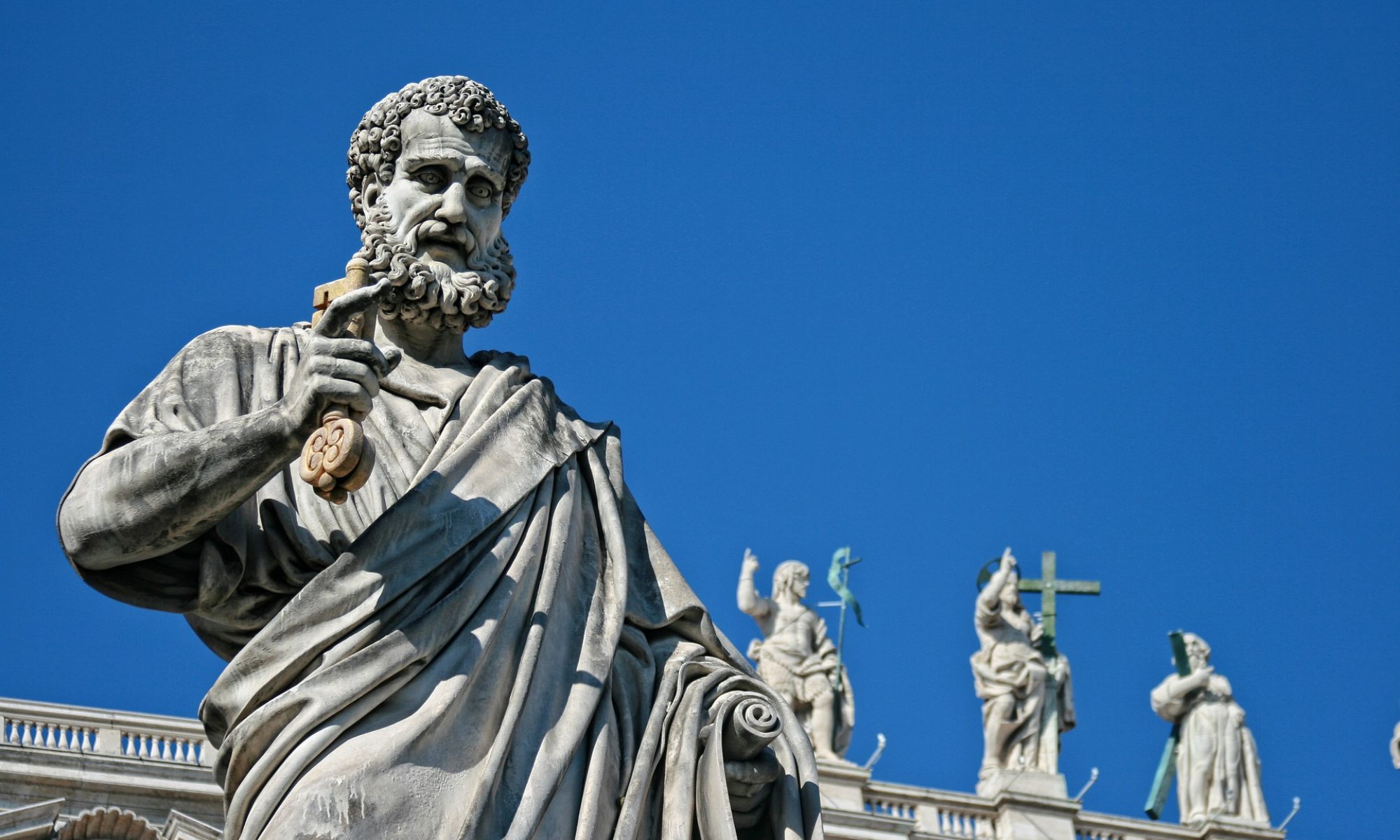


112. Peter, the Rock and the Keys: Does Matthew 16 Support the Doctrine of the Papacy?

September 1st, 2015

The most apparent and quoted evidence for the doctrine of the Papacy are the well-known words of Christ to his servant: “You are Peter and on this rock I will build my church” (Matthew 16:18). This is deemed to be the cornerstone of the Biblical doctrine of the Papacy, and is the foundation of the doctrinal and ecclesiastical development that shaped the Papacy as we now know it. These words appear in the inside of St. Peter’s basilica in a marvelous mosaic, right where the Pope exercises his office.

The interpretation of this passage has been hotly debated for centuries and its meaning is a matter of on-going debate between informed readers of the Bible.[1] Some critical commentators argue that this speech by Jesus was inserted by the Petrine party in the early church to support Peter’s role and leadership over the Pauline party and the Jacobite party. The background of this hypothesis refers to the argument between Paul and Peter in Galatians 2:11-21, and Paul’s recognition of the existence of factions in the Corinthian church mentioned after the names of the apostles (1 Corinthians 1:11-12).[2] This view, however, imposes on the canonical Bible a power struggle between the early church leaders. The early church was certainly characterized by various tensions in the inner circle of believers, but they did not reach the point of using apostolic writings as weapons to fight one another.

The standard Roman Catholic interpretation sees in this passage the embryonic stage of the doctrine of the papacy that was later developed into its full form. In it Jesus gives the person of Peter (and by implication his successors) a foundational role in the building of His Church. Subsequent traditions and practices continued to develop this role to the point in which the papacy eventually emerged. It is difficult, however, to see the organic connection between what the text says and the function of the papacy with its succession of the Petrine ministry to subsequent generations (which is not what Jesus says here), with the fundamental importance attributed to the See of Rome (which is not mentioned here), and with the imperial form that the Papacy took (which is not at all implied in the text).

Peter’s confession that precedes what Jesus says to him in Matthew 16 is reported in all three Synoptic Gospels, and is in the context of Jesus announcing His passion, His instructions to His disciples, and the Transfiguration narrative (Matthew 16:13-17:23; Mark 8:19-9:33; Luke 9:18-45).[3] Only Matthew’s Gospel, however, adds to this discourse the words: “Tu es Petrus …”. The context is Jesus’ approaching death, a necessary step towards the fulfillment of the Messiah’s mission as Savior and Lord. As He is nearing his death, Jesus asks His disciples who the people say He is, and after that, who they believe Him to be. At this point, Peter pronounces his perhaps most famous words: “You are the Christ, the Son of the Living God”. These words, however, do not originate from Peter himself. Jesus promptly replies that they come from a revelation of God. There is nothing inherently Petrine in Peter’s confession of faith. It is God who has revealed it and Peter has spoken it. The church (ekklesia), the community of Jesus’ disciples, will be built upon the truth (the rock) that Jesus is the Christ, the Son of the Living God. Jesus underlines the fact that “my” church will be built in such a way. It is not the Petrine church; it is the church of Jesus, founded by Jesus as the Messiah. “I will build my church”, says Jesus. Jesus is the Founder and the Builder of the Church, whereas Peter is a witness, a special spokesperson of this Divine truth that was revealed to him by God. Moreover, there is no indication that Peter will have successors that will take his place. It is Jesus that will build His church, not Peter or someone else after him.

In amplifying Peter’s confession, Jesus says that He will give Peter the keys of the kingdom (16:19). The symbolic significance of the keys has been outstanding for the identity of the Papacy, especially as far as his authority is concerned. The Pope is thought of as being the one who has the power of holding the keys of the church and exercising supreme control over it. In popular imagery, Peter is pictured as the one standing at the gate of heaven opening or closing its door. It is important, however, that the “keys” which Jesus refers to are put in the right Biblical context. In mentioning them, Jesus is quoting Isaiah 22:22 where Shebna, king Ezekiah’s steward, is about to be replaced by Eliakim, onto whose shoulders the keys of the house of David will be put. Opening and closing doors with keys is the subordinate role of the steward on behalf of his king. It is not a self-referential, absolute power in and of itself. It is not something that the steward can do as if he were the king. So, by receiving the keys of the kingdom, Peter will be a servant of God the King who will use them as a steward of the church that Jesus will build. “Binding and loosing” is another expression that Jesus uses to define what Peter will be called to do (16:19). It is a Jewish saying implying the exercise of discernment (e.g. forbidding and permitting) that leads to decision. In fact, Peter will be part of various decision-making processes in the church’s development that will impact the life of the community of Jesus.

As the narrative continues Jesus announces His imminent passion and death. Peter replies according to his “flesh and blood” and rebukes Jesus for doing so (16:22). Apparently Peter does not possess infallibility, nor does he exercise a divinely appointed role that is beyond the need of on-going spiritual reformation. Jesus calls Peter “satan”, one whose mind is not on the “things of God” but on the “things of men” (16:23). These words shed light on the whole passage, especially if it is interpreted as supporting a papal portrayal of Peter. Peter is safe when he follows the revelation of God and lives under His authority. Peter is utterly unsafe when he acts according to his own understanding and wants to prevail over God’s will. The point is that he is not given a leadership role beyond his spirituality. He is not given an office detached from the condition of his heart. He is not assigned a divine office that puts him on a different level than other Christian leaders. Peter is and remains a saved sinner that God will use for his purposes inasmuch as he hears the Word of God and obeys it. Matthew 16 can be seen as the Biblical basis for the Papacy only if the doctrine of the Papacy has already been established apart from Scripture and then subsequently and retrospectively squeezed into it. It is perhaps fair to say that the Papacy created the papal implications of the “Tu es Petrus …”, not the other way around.

This is an excerpt from my book A Christian’s Pocket Guide to the Papacy (Fearn: Christian Focus Publications, 2015). http://www.christianfocus.com/item/show/1617/-


[1] The standard survey of the interpretation of the passage is the volume by O. Cullmann, Peter: Disciple, Apostle, Martyr. A Historical and Theological Study (Philadelphia: Westminster Press, 1962). More recent discussions are analyzed by M. Bockmuehl, Simon Peter in Scripture and Memory. The New Testament Apostle in the Early Church (Grand Rapids, MI: Baker Academic, 2012).

[2] This reading was recently argued for by M. Hengel, Saint Peter: The Underestimated Apostle (Grand Rapids, MI: Eerdmans, 2010).

[3] For extended exegetical discussions on the passage, cfr. W. Hendriksen, Matthew (Edinburgh: The Banner of Truth Trust, 1974, reprint 1989) pp. 641-652; R.T. France, The Gospel of Matthew NICNT (Grand Rapids, MI: Eerdmans, 2002) pp. 611-628.

Video Resources on Roman Catholicism in Evangelical Perspective

August 11th, 2015

I am glad to share a number of videos that were recently released by the Forum of Christian Leaders. More resources can be found at http://www.foclonline.org/users/ldechirico

An Evangelical Account of the Roman Catholic Gospel

Is the Roman Catholic Gospel the “same” or “another” Gospel? On the one hand, there is an apparent “common orthodoxy” presumably based on common understanding of the gospel; on the other, there is a profound difference on the meaning of its basic words (e.g. Christ, the church, grace, faith, salvation, etc.). This talk explores the contours of the Gospel as they emerge from the long tradition of the Roman Catholic Church and provides an evangelical assessment of the Roman Catholic gospel as far as its biblical and apologetic significance are concerned.


Understanding and Evaluating the Roman Catholic View of Mary

Why are Roman Catholics so enamored with Mary? Why did Pope John Paul II cry out to Mary when he was shot? How is it that Mariology is a major feature in both traditional and present-day Roman Catholicism? Where did Mariology come from and what is theologically at stake in it? This talk answers these questions and highlights the need for a biblical reformation in Mariology.


Evaluating the Roman Catholic Papacy – Roundtable

In his recently published book A Christian’s Pocket Guide to Papacy, Leonardo considers the individuals who have filled the position as pope and how the Roman Catholic Church has defined their role. He also provides evangelicals with insight into the ecumenical significance of the Papacy and its prospects in our global world. This discussion evaluates the book and continues the dialogue on the Papacy with input from a number of evangelical leaders.

Understanding and Evaluating the Appeal of Roman Catholicism

Why are some evangelicals converting to Roman Catholicism? What is attractive about Roman Catholicism? What are the differences between what Roman Catholics and evangelicals believe? Are the differences substantial? This talk explores and evaluates why evangelicals find Catholicism appealing, clarifies important differences and helps evangelicals better understand their own identity.

http://www.foclonline.org/talk/understanding-and-evaluating-appeal-roman-catholicism


111. We Are Not Puritans, Are We?

August 1st, 2015

The Puritans do not generally enjoy good press. For most people the term Puritanism is synonymous with religious bigotry and judgmental moralism. This is especially true in Neo-Latin cultures where the word “Puritan” is normally associated with a derogatory caricature of Puritanism. In these contexts, Puritan is referred to as a kind of cerebral Christianity, overwhelmingly interested in outward and formal purity at the expense of human warmth and personal proximity. Pope Francis is no exception. On a recent occasion he made an impromptu reference to the Puritans. The term slipped out of his mouth as he was telling a story of a priest with a negative attitude.

What Are We, Puritans?

In delivering a meditation on priesthood to thousands of priests from around the world at the Basilica of St. John Lateran in Rome on June 12th, the Pope recalled a priest who found it difficult to baptize the child of a single mother who had asked him to do so. The priest had opposed the idea because the woman was not married and the child had been born outside of marriage. The then Archbishop Bergoglio reacted with outrage and vehemently replied: “What are we, Puritans?” In his mind there was no better description of this hypocritical and arrogant approach than naming it “puritan”! Are we Puritans? Absolutely not! “Please” – the Pope went on in his meditation – “let’s not have a Church without Jesus and without mercy. Don’t scare the faithful people. When this happens, when the priest’s heart is bureaucratic and attached to the letter of the law, the Church, which is Mother, is transformed, for so many faithful into a stepmother. Please, make them feel that the Church is always Mother”.[1]

What does Puritan mean according to Francis? Apparently it means to have a church without Jesus, a church that scares people rather than welcoming them, a bureaucratic church obsessed with the letter of the law, a church that is a rigid stepmother rather than a loving mother. In Francis’ vocabulary there was no better term to discredit this merciless form of Christianity than referring to it as “Puritanism”. But is this a fair theological and historical description of Puritanism? Surely not.

There are tons of evidence that support a very different portrait. Here is how C.S. Lewis sketches it: “We must picture these Puritans as the very opposite of those who bear that name today: as young, fierce, progressive intellectuals, very fashionable and up-to-date. They were not teetotallers; bishops, not beer, were their special aversion” (C.S. Lewis,  Studies in Medieval and Renaissance Literature [On Edmund Spenser], pp. 121-122). Instead of being cold and detached Christians, they were “worldly saints” (L. Ryken), combining a radical biblical faith with a down-to-earth interest in the whole of life.[2] Again C.S. Lewis is helpful here: “To be sure, there are standards by which the early Protestants could be called ‘puritanical’; they held adultery, fornication, and perversion for deadly sins. But then so did the Pope. If that is puritanism, all Christendom was then puritanical together. So far as there was any difference about sexual morality, the Old Religion was the more austere. The exaltation of virginity is a Roman, that of marriage, a Protestant, trait” (C.S. Lewis, English Literature in the 16th Century, p. 35).[3]

An Unsettled Relationship with Historic Protestantism

Against the term Puritan, Francis encouraged the priests to “be merciful, be merciful” – “mercy” being the key word with which to understand the Pope and the program of the fast approaching Jubilee of Mercy – as if Puritanism was opposed to a biblically-defined mercy.

Pope Francis is not new in showing profound uneasiness – even repulsion – towards what historic Protestantism stood for. In his 1985 lecture on the history of the Jesuit order he wrote severe evaluations of Luther (a “heretic”), and especially of Calvin (a “heretic” and “schismatic”) bringing about the “Calvinist squalor” in society, in the church, and in man’s heart.[4] According to that lecture, Protestantism lies at the root of all evils in the modern West. The fact that this lecture was republished unchanged in 2013 in Spanish and translated in 2014 in Italian with his permission, but without a mitigating word of explanation, indicates that this assessment still lingers in the Pope’s heart and mind.

In spite of the much applauded, yet inconsequential “words of apology” recently extended to Pentecostals and Waldensians, Pope Francis still demonstrates he has mixed feelings about the whole of the Protestant Reformation, its main architects (e.g. Luther and Calvin), and some of its historical representatives (e.g. the Puritans). In his impromptu reaction Francis echoed widespread prejudices. Surely the Puritans deserve a much fairer treatment than what the Pope gave his audience. They were not merciless Christians. In J.I. Packer’s words, the Puritans were “God’s giants” who embraced whole-heartedly a version of Christianity that paraded a particular blend of biblicist, pietist, churchly and worldly concerns.[5] The Pope is among those who instead of caricaturing Puritanism should take the opportunity to better grasp it historically, theologically, and pastorally.


[2] Leland Ryken, Wordly Saints. The Puritans as They Really Were (Grand Rapids, MI: Zondervan, 1986).

[3] Other interesting quotes by C.S. Lewis on the Puritans can be found at https://tidesandturning.wordpress.com/2012/12/26/c-s-lewis-defining-and-defending-the-english-puritans/. I wish to thank Greg Pritchard for pointing this website to me.

[4] See my Vatican File (n. 83) “What Francis Really Thinks of the Reformation and of Calvin in particular”: https://vaticanfiles.org/2014/06/83-what-francis-really-thinks-of-the-reformation-and-of-calvin-in-particular/.

[5] J.I. Packer, Among God’s Giants. The Puritan Vision of the Christian Life (Eastbourne, UK: Kingsway Publ. 1991) p. 433.

110. A “Green” Pope?

July 1st, 2015

As expected, the release of the encyclical Laudato si’ (“Praise be to you”) by Pope Francis was acclaimed as a major contribution to the urgent need for a sustained effort in environmental care. Given the breadth of the issues discussed, with this document the Pope wishes to engage not only the Christians or the like-minded people but “every person living on this planet”. It is possible that Laudato si’ will have an echo in wider circles of the public opinion (e.g. green movements and left-wing political sectors) and for a more prolonged time than a usual papal encyclical. Certainly it is the highest authoritative document that the present Pope has written so far, given that his 2013 first encyclical Lumen Fidei (“The Light of Faith”) was essentially drafted by his predecessor Benedict XVI and that his 2013 Exhortation Evangelii Gaudium (“The Joy of the Gospel”) is hierarchically inferior in the ranking of magisterial documents. More than expounding traditional doctrinal points, Francis wants to underline wide-spread concerns and to show the open-mindedness of the Roman Catholic vision to address them. The reference to a well known prayer by Francis of Assisi in the title reinforces the intention to recall a long tradition and to attract a wide attention.

Environmental Concerns and Roman Catholic Emphases

In 192 pages (a fairly long length for an encyclical), six chapters, the usual invocation to Mary “the Mother and Queen of all creation”, and two closing prayers, Pope Francis delineates his concerns for the deteriorating health of planet earth and calls humanity to take action in order to stop the degenerating process. The remedy to the downgrade trajectory is the adoption of an “integral ecology” which will lead to a “sustainable and integral development”. After analyzing what is happening at our “common home” in terms of pollution and climate change, access to water, loss of biodiversity, decline in the quality of human life, and global inequality, the Pope touches on the cultural and social distortions that cause the present-day ecological crisis (e.g. pervasive technocracy and distorted anthropocentrism) and suggests the “gospel of creation” based on “common good” principles and applied to the social and cultural levels as the solution for it.

The document strikes the cords of the wide-spread environmentalist mentality. At the same time it is part and parcel of the Social Doctrine of the Roman Catholic Church. This means that its analyses and proposals are interspersed with typically Roman Catholic elements. For instance, apart from the Marian title of “Mother and Queen of creation”, there is a strong sacramental language in the final part of the document whereby the Eucharist is presented as the “greatest exaltation” of creation: “Joined to the incarnate Son, present in the Eucharist, the whole cosmos gives thanks to God. Indeed the Eucharist is itself an act of cosmic love”. “In the bread of the Eucharist, creation is projected towards divinization, towards the holy wedding feast, towards unification with the Creator himself” (236). Another specific Catholic emphasis in calling for an “ecological conversion” is the insistence on the role of global agencies and organizations while there is little stress on personal conversion. In the papal document sin has more social than individual dimensions. The thoroughgoing reference to the role of education in overcoming the ecological crisis tends to be a humanistic wishful thinking more than a sober Christian comment that has a realist view of humanity’s ability to deal with its problems.

Evangelical Parallel Resources

Laudato Si’ will prove to be a useful reading to penetrate what is central in the Pope’s vision: the poor, universal brotherhood, a sacramental vision of the world, and an appeal to the secular public opinion. In coming to terms with this encyclical, Evangelicals should be aware of what their own tradition has already produced on these pressing issues.

The 1980 Lausanne Occasional Paper “An Evangelical Commitment to Simple Life-style”(http://www.lausanne.org/content/lop/lop-20) is a compelling reminder of our biblical vocation to live soberly and to promote justice. The 2008 document by the World Evangelical Alliance “Statement on the Care of Creation” (http://www.weacreationcare.org/wp-content/uploads/2014/12/WEA-Statement-on-Care-of-Creation.pdf) tackles the challenges of being faithful stewards of God’s creation in a biblically responsible way. Finally, the 2010 Cape Town Commitment (http://www.lausanne.org/content/ctc/ctcommitment) is a passionate call to a Christian life-style marked by humility, integrity and simplicity.

These documents are much better grounded in the biblical doctrine of creation, the fall, and Christ’s redemption than the papal encyclical. They are also framed in the context of an evangelical concern for evangelism and mission, thus reflecting a more biblical and holistic approach than Laudato Sì’. A comparative study between these evangelical documents and Francis’ encyclical will be a good exercise for all those who want to come to terms with what the two main global Christian families are saying and doing about the environment.


A Christian Pocket Guide to the Papacy. A Book Review by Chris Castaldo

Here is a review of my book on the papacy by Chris Castaldo (PhD, London School of Theology), lead pastor of New Covenant Church in Naperville, Illinois. He is the author of Talking with Catholics about the Gospel. Chris blogs at www.chriscastaldo.com.

Leonardo De Chirico. A Christian’s Pocket Guide to the Papacy: Its Origin and Role in the 21st Century. Ross-shire, Scotland, UK: Christian Focus, 2015. 128 pp. $7.99.

The office of the papacy is an enigma to most evangelical Protestants. The spectacle of medieval regalia, papal coronation, gem-studded tiara (several of which are displayed at the Vatican), red leather loafers, and the popemobile tend to provoke curiosity, skepticism, and bewilderment. Add to these visible symbols the pope’s claim to supremacy, monarchial titles (over the Vatican, of which he is a head of state), infallibility, and a standing army, and the portrait gets even more perplexing.

Cutting through the fog of mystery and confusion is Leonardo De Chirico’s new book, A Christian’s Pocket Guide to the Papacy: Its Origin and Role in the 21st Century. De Chirico is ideally suited to write this volume. An Italian historical theologian with specialization in Roman Catholic history and thought, he has spent numerous years teaching in the Eternal City. He sits at the table in ecumenical dialogue with Vatican scholars while simultaneously pastoring a Protestant congregation (which he planted in partnership with Redeemer Presbyterian Church’s City to City initiative). Consequently, we’re getting a treatment that is in some sense “insider,” intimately acquainted with the finer points of the Vatican, and at the same time thoroughly evangelical, rock-ribbed in its commitment to Scripture’s supreme authority.

De Chirico begins by examining the historical development of the papal office through its titles and symbols. Readers are then escorted to the Sistine Chapel to observe cardinals in conclave (“from the Latin cum clave, “locked up with a key”). By the way, such parenthetical definitions fill each chapter, providing insight into a myriad of Latin expressions (e.g., Pontifex Maximus, plenitude potestatis, ex-cathedra). A couple of paragraphs later, he consults the Catechism of the Catholic Church to note how such formulations are explicitly defined by contemporary Roman Catholic teaching. Whether it’s the “keys” of Peter, the pope’s throne, or his pallium (a woolen cloak), De Chirico explains how such symbols convey the form and substance of papal authority.

to continue reading the book review, please go to

http://www.thegospelcoalition.org/article/a-christians-pocket-guide-to-the-papacy

Another review of the book by James Dudley-Smith was published on Evangelicals Now (July 2015) p. 26 (https://www.e-n.org.uk/2015/07/reviews/rome-alone/)

I am also pleased to announce the publication of the Italian edition of the book

Il papato. Una guida evangelica, Firenze, BE Edizioni 2015, pp. 116.

http://www.beedizioni.it/shop/48-il-papato-.html


Il papato. Una guida evangelica

”Gaudium magnum: habemus papam”

Questo annuncio presenta un nuovo papa al mondo. Il papa è uno degli ultimi esempi di sovranità assoluta nel mondo moderno e rappresenta una delle istituzioni più antiche, anche se nel 2013 l’attuale papa Francesco è stato nominato dal Time “persona dell’anno”. Questo libro risponde alle seguenti domande introduttive: chi è il papa e in che modo la chiesa cattolica romana definisce il suo ruolo? Che relazione c’è tra Pietro e il papa? Pietro è stato il primo papa? Come può una posizione di guida nella chiesa cristiana avere assunto una forma così “imperiale”? Perché Roma è stata così importante in questo processo? Come veniva visto dai riformatori protestanti del XVI secolo e oltre? Che cosa si può dire dei papi contemporanei? Qual è il significato ecumenico del papato e quali sono le sue prospettive nel mondo globale? Queste e altre domande costituiscono lo sfondo delle nostre indagini sull’intreccio biblico, storico e teologico del papato da un punto di vista evangelico.

Video of the presentation of the book at the National Book Fair in Torino

An interview on the contents of the book