195. The Latest Evangelical Convert to Rome. What Does Rome Have to Offer?

I am not English, nor Anglican, but the story of the conversion of the former Anglican bishop Michael Nazir-Ali to Catholicism struck me. He is not the first evangelical Anglican to become Roman Catholic, and he probably will not be the last. He stands on a tradition that has important antecedents like the conversion to Rome of John Henry Newman (1801-1890) and many more. However, Nazir-Ali was a well-known evangelical Anglican who belonged to the “evangelical” family and was a respected voice in that world.

Nazir-Ali. CREDIT: ALAMY

Transitions of this kind have personal motivations that ultimately only the Lord knows and the person(s) involved are aware of. This is to say that speculations are out of place. What is instead possible – and indeed necessary – is to reflect on the public and theological issues involved.

Here are a few remarks that can make us think. Commenting on it, the renowned evangelical thinker Os Guinness in a recent interview said: “Institutionally, the switch makes great sense… Rome is a far more prestigious liner to sail in than the battered barque of Lambeth”. However, “in terms of the Gospel itself, the switch makes no sense, and I hate to think that ecclesiastical factors outweighed theological factors at the end of the day”. And again: “the humblest West African church in the land, still faithful to the Gospel, would have been a better destination.”

In the same article, the Rev. Roger Salter added further food for thought: “How can Rome be the Home for any authentic adherent of the Augustinian 16th century Reformation where the doctrine of grace regained its bold and beautiful clarity? … Rome is as deeply divided as Anglicanism between the progressives and the orthodox. And the present pope not only betrays his own persecuted Church (in China, for example) but embraces a range of heresies, including universalism.” 

These comments underline important points and indicate at least two main flaws. Let me briefly elaborate on them.

The Danger of an Idealized View of Rome
Bishop Nazir-Ali’s concerns over the trajectory taken by the Anglican Church on some key doctrinal and moral issues made him look at Rome as a much safer place to identify with. Rome’s image was perceived as being a traditional, stable, authoritative institution with an aura of doctrinal and moral integrity.

As often happens in similar stories, given its “Roman” dogmatic and hierarchical structure, Rome is viewed as a safe haven in the turmoil of our day, a bulwark against liberal and secularizing forces, and a better place to find refuge and support. The question is whether Bishop Nazir-Ali is aware of the evolutions of Roman Catholicism under the papacy of Francis, which are the result of trends stemming from Vatican II. They not only relate to the “uncertain teaching” of the present Pope, but belong to well-established trends in contemporary Catholicism.

One example will suffice. In terms of its universalist trends, since John Paul II and even more so under Francis, Rome encourages joint prayer with Muslims given the fact that according to Vatican II they “along with us adore the one and merciful God” (Lumen Gentium 16). We are “all brothers” (to quote the title of the latest papal encyclical) after all, not only with Muslims but with the whole of humanity. Roman Catholicism has re-engineered the language of “brotherhood and sisterhood” replacing its spiritual meaning (i.e. belonging to the same family as believers in Christ) with a biological one (i.e. belonging to the same human species). This replacement has immense theological, soteriological, and missiological overtones. It is another way of saying that we are all children of God, we are all saved in following our different religious journeys, and we Christians no longer need to look for conversions to Christ from among people of other religions.

Pope Francis regularly asks Muslims to pray for him because we are all “children of God” and says that atheists go to heaven because, after all, they are good people. Though biblically untenable, these “politically correct” positions can be heard in the Anglican Church but also at the highest level of Roman Catholic teaching authority.

In many respects, in fact, the doctrinal and moral confusion that made the Church of England no longer bearable for Bishop Nazir-Ali is very similar to the one that Roman Catholicism has been going through since Vatican II. That confusion is even more evident today, given the many moral and financial scandals that have shown the brokenness and failures of the Roman Catholic system.

As it is “Roman,” i.e. centered on a hierarchical structure that gives an idea of stability, Rome is also “catholic,” i.e. a sponge capable of “updating” and developing itself to adapt to the changing situations. Has Bishop Nazir-Ali fallen prey to a shortsighted, selective and, in the end, idealized view of Rome – a sort of wishful thinking in times of personal crisis? Has he really grasped the present-day reality of Roman Catholicism as a whole before embracing it?

The Risk of Going from Bad to Worse
There is a further – and perhaps more important – point to be made. Rome is no better than Lambeth, and not only in terms of its unstable and unreliable doctrinal and moral standards. Rome is no better a place because it has created a theological system that is not committed to Scripture Alone, nor to Christ Alone and Faith Alone. In other words, Rome does not embrace the biblical gospel as it was rediscovered at the Protestant Reformation, although it contains elements of a “conservative” religious culture that is nonetheless rapidly evolving towards a more pluralist and inclusivist position.

As an evangelical, Bishop Nazir-Ali should have had enough spiritual awareness to see what is at stake with Roman Catholicism from a doctrinal viewpoint. How can a Church, like the Roman Catholic Church, that is dogmatically committed to salvation by faith and works, an augmented canon of Scripture, the intercession of the saints and Mary, a host of spurious devotions and practices, Eucharistic adoration, papal infallibility, the dogmas of Mary’s immaculate conception and bodily assumption, and so on be a better place for a Christian who is concerned with biblical truth and the gospel of Jesus Christ?

Despite some areas of apparent and formal agreement (e.g. the Nicene creed), there are even deeper disagreements with Rome. The vocabulary of Nicaea is the same: God the Father, Jesus Christ, salvation, Holy Spirit, virgin Mary, church, a holy apostolic catholic church, baptism, remission of sins, but while the words are shared, the same cannot be said of their theological meaning. When a Roman Catholic refers to the “virgin Mary”, to “salvation”, to “the church”, etc., they mean things that are far from plain biblical teaching. The recent “catholic” moves in Roman Catholic doctrine and practice (e.g. historical-critical readings of Scripture and universalism in salvation) make the difference even sharper.

The 2016 article Is the Reformation Over? A Statement of Evangelical Convictions, signed by dozens of evangelical global leaders, says it well: “The issues that gave birth to the Reformation five hundred years ago are still very much alive in the twenty-first century for the whole church. While we welcome all opportunities to clarify them, Evangelicals affirm, with the Reformers, the foundational convictions that our final authority is the Bible and that we are saved through faith alone.” Rome does not share these convictions.

Ours is not the time to cross the Tiber. On the other side of the river, the reality is different from what it appears to be and, even more importantly, it is flawed in terms of its basic commitments. Ours is the time to continue to uphold the biblical gospel of Jesus Christ. I don’t know if Lambeth is the best place for a believer to find his spiritual home, but certainly, Rome is worse.

194. Christ Unfurled or the Roman Catholic Christ-Church Interconnection. Evangelical Remarks on David Meconi’s latest book

“Christ and his Church thus together make up the ‘whole Christ’ (Christus totus). The Church is one with Christ.” Here is how the 1992 Catechism of the Catholic Church (§ 795) hammers out one of the two axes of the Roman Catholic theological system, i.e. the Christ-Church interconnection (the other being the nature-grace interdependence). If one wants to come to terms with the deep structure of the theological vision of Rome, they must begin by addressing this critical Christological-ecclesiological point whereby Rome considers itself the prolongation of the incarnation of Jesus Christ.

In his masterful book Roman Catholic Theology and Practice. An Evangelical Assessment (2014), Gregg Allison has done a great service in highlighting the foundational importance of the nexus between Christ and the Church for the whole Roman Catholic framework. Every doctrine and every practice occurs between the two axes: on the one hand an optimism about nature (regardless of the covenant-breaking brought about by sin) and on the other inflating the claims of the church that acts as another Christ. Now, from within the Roman Catholic tradition, David Meconi, S.J. reinforces the crucial importance of the fact that “the Church and Christ really are one” (2) given the fact that the Church is “an extension of Jesus Christ himself” (2).

Meconi is academically well-qualified to write from a conservative Roman Catholic perspective. In the past I have read his The One Christ: Saint Augustine’s Theology of Deification (2013) and consulted The Cambridge Companion to Augustine (2014) of which he is one of the chief editors. He is a Roman Catholic Augustinian scholar with a particular interest in a “whole Christ” theology. With the recent book Christ Unfurled: The First 500 Years of Jesus’s Life (Charlotte, NC: Tan Books, 2021) Meconi labours on the Christ-Church interconnection even more closely, thus offering an account of what it means for Roman Catholic theology to affirm that “the Church is a replication of the incarnate God’s own human and divine life” (6).

The Early Centuries
He does it by emphasizing the historical perspective, i.e. reading the five centuries of the Christian church as if they were “the first five hundred years of Jesus’ life on earth” (14). Since “the Church is the extension of Christ’s very incarnate self” (15), the Church is therefore Christ unfurled as the title of the book indicates. In the first chapter, the thesis is repeatedly stated: “The Church is the unbroken continuation of Christ’s own incarnate self, the extension of his divine and human presence on earth” (17) so that “post-Ascension people could see, hear, and still touch the Lord” (17). Moreover, “The Church as founded by Jesus Christ is the continuation of his own divinely human, or humanly divine, life” (19). The unfurling of Christ in the church stretches to His work of salvation, establishing an interconnection between the cross of Calvary and the chief sacrament of the Church; in fact, “in and through his Church, the life-giving Body and Blood of Jesus continue to be with us in the Most Holy Eucharist” (19-20). Reiterating the point, Meconi goes as far as saying that “the hypostatic union of the incarnate Son’s humanity and divinity continues in the unity of the Eucharistic sacrifice” (114).

In subsequent chapters, Meconi attempts to prove that this Roman Catholic view has been upheld in the church since the beginning. As for Apostolic Fathers (e.g. Clement of Rome and Ignatius of Antioch) and in writings such as the Didache and The Shepherd of Hermas, he argues that the early Christians understood themselves “as envoys and extensions of Christ’s very presence in the world” (30). However, the proofs given for such a strong statement are less than convincing. In fact, the “canonicity of Scripture” (i.e. the recognition of the inspired books of the Bible) and the “rule of faith” (i.e. the comprehensive summary of the gospel) which the Apostolic Fathers were interested in are hardly early attestations of the Christ-Church interconnection. They are simply some of the concerns that the early church had in trying to faithfully live after the death of the apostles. Their tendency toward “monoepiscopacy” (i.e. one bishop over each local church) is more of an unfortunate influence of Roman imperial authority structures than a sign of their endorsing the “whole Christ” theology. As for later Fathers, Meconi is right in saying that, for example, Tertullian spoke of the church as the “mother Church” and Origen of the “bride of Christ” (69), but these two titles given to the church do not intrinsically imply the theology of the extension of the incarnation, unless one wants to see it retrospectively, having already decided that this is what he wants to see.

The Legacy of the Creeds
Examining the legacy of the early councils and creeds (Nicea and Constantinople) which focussed on the trinitarian nature of God and the divine and human natures of the person Jesus Christ, Meconi makes the point that “Jesus Christ founded a Church so he would have a visible locus, a freely-chosen Body, unto whom he could extend his life” (135). Again, this is an inference that stretches what the creeds say by filling in the terms with meanings they don’t have. The language of “extension” and “continuation” is not found in the creeds. The union or fellowship between Christ and the church (or the believers) is certainly maintained, but whether this relationship points to the “extension” of the incarnation is beyond what the texts of the councils say. In order to cross the boundaries between the incarnation of Jesus Christ and the life of the church, one needs further theological elaboration than what can be found there.

Finally, a long section of a chapter is dedicated to Augustine’s views of the “whole Christ,” Meconi’s own area of expertise. According to him, “for Augustine, the ‘whole Christ’ is not just Jesus now seated at the right hand of the Father but the entire Christ is Jesus as well as those whom Jesus loves” (182). Together they form “one mystical person” (197). This is accurate as far as Augustine is concerned, although in Augustine there is also a strong emphasis on the distinction between Christ and the church and the submission of the latter to the former. On this point, Augustine is at best confused. I have written elsewhere of the damages of Augustine’s formula (totus Christus) and the corrections brought about by the Protestant Reformation in stressing the uniqueness of Christ (solus Christus).

The Whole Christ or Christ Alone?
On the axes of the Christ-church interconnection,Rome builds its self-understanding as a church endowed with the authority of Christ the King, the priesthood of Christ the Mediator, and the truth of Christ the Prophet. The threefold ministry of Christ as King, Priest, and Prophet is thus transposed to the Roman Church – in its hierarchical rule, its magisterial interpretation of the Word and its administration of the sacraments. But this is not what the gospel teaches. This is an inflated view of the church based on a defective view of Christ. According to Rome, there is never solus Christus (Christ alone), only Christus in ecclesia (Christ in the church) and ecclesia in Christo (the church in Christ).

The emphasis on the Christ–church interconnection seems to forget that the Church is made up of creatures (human beings). Because the church is made up of creatures, it is part of creation, and is not the creator, while Christ is the divine Creator, the One from whom all things are and who is perfect now and always. When we talk about Christology, we are talking about the unique relationship between human nature and divine nature in the person of Jesus Christ from the perspective of the Creator; when we talk about ecclesiology, we are talking about the people of God, the Body of Christ and the Temple of the Holy Spirit – all of these titles referring to a created reality. The distinction between Creator and creature is decisive for not falling into the trap of elevating the church into a quasi-divine body.

After the Ascension to the right hand of the Father, Christ did not continue his incarnation in the church. Having formed the church through his finished work on the cross, He sent it to the ends of the earth and empowered it with the Holy Spirit to preach and to bear witness to his gospel of salvation. Christ is the head of the church, and the church serves His purposes and His alone, until He comes again.

193. The Church is Burning, What Can Be Done? On Andrea Riccardi’s Insights on the Crisis of Present-Day Roman Catholicism

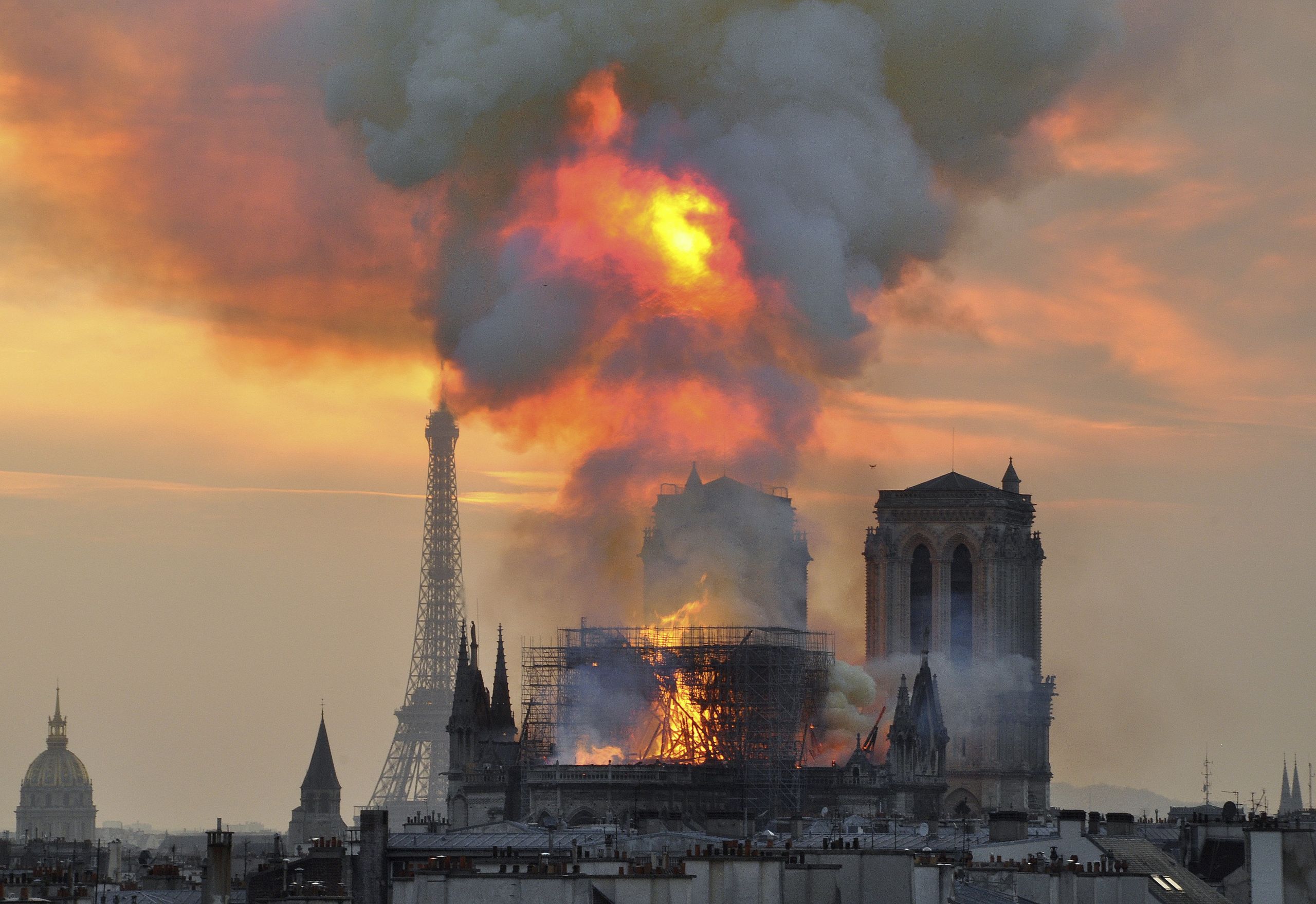
(AP Photo/Thibault Camus)

The fire at Notre-Dame Cathedral in Paris (April 15, 2019) is a symbol of the church that burns in secularized Europe and, more generally, in the globalized world. Andrea Riccardi’s book, La Chiesa brucia: Crisi e futuro del cristianesimo (The Church Burns: Crisis and Future of Christianity) (Bari-Rome: Laterza, 2021) starts with the evocative image of the burning Notre-Dame.

Riccardi is well-positioned to bring forth his analysis, being professor of Contemporary History at the University of Rome III and a biographer of John Paul II. He is also known internationally for having founded, in 1968, the Community of Sant’Egidio, one of the most active ecclesial lay movements within the Roman Catholic Church. In addition to his social commitment and his many development projects in the southern hemisphere, Riccardi played a role in mediating various conflicts and contributed to attaining peace in several countries, such as Mozambique, Guatemala and the Ivory Coast. In 2003, TIME magazine included him onits list of thirty-six “modern heroes” of Europe, individuals who stand out because of their professional courage and humanitarian commitment. He is an insiders and scholarly voice on the inner dynamics of Roman Catholicism. 

The Notre-Dame cathedral is in the center of Paris, in the heart of Europe, embedded in its history and an emblem of its culture. It burned and, by burning, it represents the state of profound crisis in which (Roman and institutionalized) Christianity finds itself. This is not fake news, but a factual observation. Practitioners are declining across the continent, vocations are collapsing everywhere, traditions are eroding and entering the tunnel of oblivion, adherence to belief and morals are plummeting, and local parishes are in an identity crisis. The processes of secularization seem unstoppable and are dismantling the bricks of institutional religiosity one piece at a time. The church is certainly experiencing a period of decline. Does it even risk disappearing?

In painting this fresco in dark colors, Riccardi documents the indicators of the crisis of Roman Catholicism and he does so keeping in mind the various national quadrants (France, Italy, Spain, Germany) with their particularities. He also dwells on the forms of “national-Catholicism” (Hungary and Poland) which are attempts to intertwine religion and national identity to make Roman Catholicism and cultural Christianity a sort of religious-civil bulwark in the face of contemporary disorientation.

The crisis, according to Riccardi, starts from afar. In fact, the question of whether European Christianity was about to die had already been posed by Jean Delumeau in 1977 (Is Christianity about to die?) and, even earlier, by the French cardinal Suhard in 1947 when he spoke of “decline”. From this point of view, Vatican II (1962-1965), with its “pastoral” focus, was a response to the crisis. Indeed, Vatican II was an attempt to embrace the modern world by re-understanding it on the side of the enlarged catholicity of Rome, rather than stubbornly bringing it back to the Roman canons from which it seemed to have taken leave. With Evangelii Nuntiandi (1975) Paul VI launched a call to “evangelization” as a method to regain ground after having lost it with Humanae Vitae on sexual morality (1968). The effort did not produce the results hoped for. The long wave of the 1968 revolution actually dug deeper the gap between Europe and the church (and inside the church itself). While Roman Catholicism has proven equipped to tackle the social question (e.g. mitigating Capitalism) and political ideologies (e.g. against Communism), it has not been able to stand up to contemporary individualism, sexual libertarianism, and unbridled and globalized consumerism. 

The long and energetic pontificate of John Paul II seemed to make up ground, but, in reality, it covered the crisis rather than solved it. With Benedict XVI, the crisis reached a culminating point with the shocking resignation of the Pope. Following the pastoral “spirit” of Vatican II, Pope Francis is trying to further widen the mesh of catholicity to build bridges with the “first unbelieving generation” (p. 116) on the basis of mercy for all, universal brotherhood, and care for the environment, all themes very distant from traditional “Roman” and institutional Catholicism. How effective this strategy will be remains to be seen, though it does not appear to have reversed the course.

As a Catholic scholar, Riccardi talks about the crisis and points out some ideas for a different future. He takes up the argument by French sociologist Hervieu-Léger that Roman Catholicism has characterized itself as a “cold religion” (top-down and moralistic) and should melt, learning to become “warmer”. This means, for example, living in the contemporary world with “multiple ecclesial presences, capable of charismatic, diversified, close encounters, and in dialogue with the people” (p. 207). It is not surprising that the founder of Sant’Egidio supports the role of ecclesial movements as horizontal Roman Catholic players, capable of interfacing with different niches of secularized society, intercepting particular needs, “freeing” the relationship with religion with respect to the only channel represented by the institutional church and, therefore, offering a range of different and more contextualized “Catholic” responses. Given that Roman Catholicism has the Eucharist at its center and that it takes a priest to administer the sacrament, to remedy the lack of priests Riccardi goes so far as to support the possibility of recognizing married priests (pp. 199-203).

The analysis of the crisis suggested by the book is honest and without reticence. And yet, the imagined way out remains within the intangible framework of the pillars of Roman Catholicity. It seems that, for Riccardi, in the face of the ongoing fire, the answer must beat the level of a “pastoral” attitude, without providing for a doctrinal rethinking of the self-understanding of the Church of Rome. 

The Church is burning, to borrow Riccardi’s language, but in the end is untouchable in its core elements. The hierarchical structure, the sacramental framework, the theology founded not on Scripture alone but on Tradition (that both includes Scripture and is bigger than Scripture), the non-biblical dogmas, the absorbed spurious devotions, etc., all this cannot be changed. In the end, faced with a very serious diagnosis, the imagined cure seems to be a placebo. If the church burns, the best minds of Roman Catholicism (and Riccardi is one of them) are not compelled by the need to go deeper into understanding the reasons for the crisis. They are not open to a biblical reformation. 

For all churches and for all Christians, the turning point is not a greater pastoral attention nor a new missionary strategy (however important these factors might be), but a return to the Word of God accompanied by repentance from sin and a response of faith ready to call into question all the compromised structures built over time. These are the steps towards the “future” of Christianity as is evoked in the subtitle. The fire of secularization risks incinerating the church, but to borrow the title of a book by Michael Reeves, the unquenchable flame of the reformation according to the Gospel can eliminate the accumulated toxins and open the way to a path of conversion. The ultimate issue is not to switch from a “cold” to a “warm” religion; it is to faithfully respond to the biblical gospel of Jesus Christ in truth and love.

192. Who Will be the Next Pope?

There is a general perception that Pope Francis’s pontificate has entered an irreversibly declining phase, a sort of late autumn that is a prelude to the end of a season. It is not just a question of age: yes, Pope Francis is elderly and in poor health. But aging aside, the pontificate finds itself navigating a descending parable. It started with the language of “mission” and “reform”. Francis’ reign, now nearly 10 years old, was immediately engulfed in a thousand difficulties, particularly within the Catholic Church. Many of these problems were caused by the ambiguities of Francis himself, to the point that the push envisaged at the beginning turned out to be broken, if not wholly inconclusive.

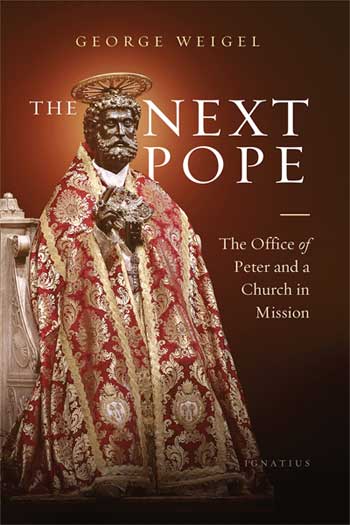
Given the predictable end of a season, the question is therefore legitimate: after Francis, who is next? Who will be the next pope? This question is asked not by some bitter secularist or even a seasoned bookmaker, but by the devout Roman Catholic scholar George Weigel, former biographer of John Paul II (Witness of Hope. The Life of John Paul II, 1999) and author, among other things, of a book in which he proposes a change in the meaning of the term “evangelical”: from being a descriptor of the Protestant faith grounded on Scripture Alone and Faith Alone to an adjective describing a fully-orbed Roman Catholicism (Evangelical Catholicism. Deep-reform in the 21st Century, 2013, see my review here). Weigel is a bright intellectual and an exponent of the conservative American Roman Catholicism that has often been outspoken against Francis.

In his book The Next Pope. The Office of Peter and a Church in Mission (San Francisco, CA: Ignatius Press, 2020) Weigel draws a composite sketch of the new pope.[1] The next pope will be a man who was either a child or very young during the years of the Second Vatican Council (1962-1965). For the first time, Rome will have a pope more “distant” from the controversies of the 1960s-1970s. For this reason, perhaps he will be more free from the interpretative wars over the Council, i.e whether it was a Council that continued with tradition or broke from it. However, as Weigel admits (but it doesn’t take much acumen to recognize it), “there are profound divisions over Catholic doctrine and identity, praxis and mission, within the Church itself” (p. 9). The next pope will find these divisions on his desk. How will he deal with them?

According to Weigel, the next pope will have to find inspiration from Leo XIII (1810-1903), whose papacy from 1878 to his death in 1903 generated a ferment in the life of the then tormented church: Leo anchored its life and thought to Thomist philosophy; he developed its social doctrine; and launched a challenge to the modern world at the cultural level instead of adopting a defensive attitude towards it. The reverberations of this vitality were then channeled by John XXIII in convening Vatican II and by John Paul II in the Great Jubilee of 2000. For the American scholar, this is the militant Roman Catholicism that the next pope will have to embody and promote: faithful to its traditional doctrine, integral in its moral teaching, consistent in its ecclesial practices, made up of devout Catholics. For Weigel, taking inspiration from Leo XIII and John Paul II, the agenda of the new pope needs to be the “new evangelization”. Here is the way he puts it: the new pope “will have to devote himself fully to the new evangelization as the great strategy of the Church of the 21st century” (p. 23).

In order to “evangelize”, the Roman Catholic Church must, according to Weigel, regain its identity as a sacramental and hierarchical church, combining this with its consolidated cluster of doctrines and practices handed down by tradition, i.e. the “fullness of the Catholic faith”. Weigel warns Roman Catholicism against going down the bankrupt path of liberal Protestantism which, by way of adapting to modern times, has lost its convictions and has also seen its churches empty. From his North American point of view, Weigel says that “the growing branches of Protestantism in the world are evangelicals, Pentecostals or fundamentalists” (p. 56), all characterized by “clear teaching and firm moral expectations”. It is as if to say: Roman Catholicism can follow the path of liberal Protestantism, become “light” (that is, confused in doctrine and mixed with the world) and die, or it must recover its “full” identity and flourish again. For Weigel, “light Catholicism will lead to zero Catholicism” (p. 59), the loss of faith and a dissolutive process. For this reason, he hopes that the next pope will be the expression of a full, convinced, devoted Roman Catholicism that aims at “evangelizing” (that is, Catholicizing) the world rather than being penetrated by the world.

This language of “light” versus “full” Catholicism helps explain why Weigel is critical of Francis. The present pope is seen as embroiled in proposing a “light” form of Roman Catholicism: he speaks of “mission” (e.g. in the apostolic exhortation Evangelii Gaudium), but he works it out in a very different way from the “new evangelization”. For Francis, mission is to go out to meet “all brothers” (i.e. Francis’ latest enclycical argument for a universal brotherhood) with mercy, highlighting the unity that already exists among all human beings without lingering over differences. The strategy is to avoid facing disputes, not to challenge anyone, and to express mercy without a doctrinal backbone. Quite the opposite of what Weigel is hoping for. It is clear that Weigel’s new pope will have to make a vigorous shift away from Francis’s trajectory.

Weigel often uses a kind of “evangelical” language to describe the pope of his dreams. He speaks of fervor of spirit and solidity of convictions, all indicators not so much of doctrinal contents, but of the experiences of the evangelical faith. At the same time he speaks a very Roman Catholic language: he refers to salvation through baptism, Roman hierarchy, papal primacy, and Marian devotions. As a traditionalist Catholic, Weigel believes that everything Roman Catholicism has collected througout history (e.g. the Council of Trent, Vatican I, Marian dogmas, etc.) should be kept and nothing lost. All of this is very Catholic. He wants to make people believe that Roman Catholicism can (indeed must) also be “evangelical” without losing its Catholic tenets. He has in mind a pope who is very traditional in doctrine (anti-evangelical), yet very passionate and committed like an “evangelical”. This is the kind of pope he hopes for.

When he was elected in 2013, Francis too was presented as very close to the “evangelical” ethos. Spontaneous prayer, experiential language, and a certain fervor in spirituality seemed to make him a different pope. Many evangelicals were impressed, only to discover some time later that Francis was and is also very Marian, universalist, Jesuit, and anti-evangelical. Now Weigel, indirectly criticizing Francis, hopes for an “evangelical” Catholic pope, even if a very different pope from the present one. Both Francis and Weigel have an experiential (non-doctrinal) meaning of “evangelical” in mind. They want to appropriate the evangelical ways of living out the faith, while remaining anchored to the traditional (Weigel) or “outgoing” (Francis) doctrine of Roman Catholicism. Both of them distort the evangelical faith and want to dissolve it in the dogmatic-institutional synthesis of Roman Catholicism.

Whoever is elected, the next pope will unlikely be an “evangelical” if the word “evangelical” retains its doctrinal and historical meaning. The “evangel” is not the paramount commitment of the Roman Catholic Church. Therefore, its head will never be an “evangelical” pope if the Roman Church will not undergo a reformation according to the “evangel”.


[1] I had access to the Italian translation of the book Il prossimo papa. L’ufficio di Pietro e la missione della chiesa (Verona: Fede & Cultura, 2021) and quotations will be taken from it.

191. John Stott (1921-2011) and His Contribution to an Evangelical Analysis of Roman Catholicism

(Summary of a lecture held in Rome at the Istituto di Cultura Evangelica e Documentazione on 12 June 2021 as part of the series “1921-2021: The Evangelical Faith Between Yesterday and Tomorrow” marking John Stott’s centenary. I wish to thank my friend and colleague Reid Karr for sharing the responsibility of the lecture, especially as far as the second section is concerned. A video of the lecture in Italian can be found here).

John Stott’s international stature and influence on the evangelical movement of the 20th century have been widely recognized and appreciated. His global standing in present-day evangelicalism makes him a towering figure also to be consulted on the relationship between the evangelical faith and Roman Catholicism. By helping post-World War II evangelicals to regroup around the biblical gospel and for the Christian mission, Stott also had a role (albeit not a primary one) in influencing the evangelical reading of Roman Catholicism that emerged from the Second Vatican Council (1962-1965). Stott did not write a book on Catholicism and therefore did not have the opportunity to develop his analysis in an in-depth way. However, there are significant traces in his books and in the initiatives in which he had a leading role that can be assessed. This article will focus on three moments in Stott’s contribution to the evangelical analysis of Roman Catholicism. The first is based on his book Christ the Controversialist (1970), the second on his involvement in the “Evangelical-Catholic Dialogue on Mission” (ERCDOM 1977-1984), and the third on what is stated on the subject in the “Manila Manifesto” (1989).

The Controversialist
In the cultural climate of the late Sixties that wanted a soft and inclusive Jesus (more of an inspirational friend than the Savior and Lord of our lives), Stott wrote a courageous book for that time. The title is programmatic: Christ the Controversialist: A Study in Some Essentials of Evangelical Religion. The Jesus Christ of the Bible is not a nice guy who gets along with everyone, but one who unites because he divides, who challenges, who unmasks hypocrisies. Stott has three main interlocutors in view: one is theological liberalism that would like a “moral” but not doctrinal Jesus; the other is downward ecumenism that wants unity without truth; and the third (although less treated than the first two) is Roman Catholicism that places the church before Christ. To these deviations, Stott contrasts the evangelical faith which, for him, is nothing but biblical Christianity.

In the aftermath of Vatican II, Stott is aware that Roman Catholicism is in a transition phase. He shows particular attention to the fact that Rome has opened the doors to the circulation of the Bible among the laity, overcoming the age-old resistance to a direct access to Scripture by the faithful. This “greater biblical awareness” can have “incalculable consequences” (p. 79). That said, Stott also points out that Catholicism, although involved in a process of “updating”, has in no way changed any of the anti-Protestant positions of its remote and recent past. What matters most is that the non-biblical practices elevated by Rome to identity markers (e.g. the auricular confession to the priest) are still there. Particularly critical is Stott’s reading of the “Credo of the People of God” which Paul VI promulgated at the conclusion of the Council to emphasize Catholic fidelity to its confessional principles: Mariology, the papacy, and the Mass. For Stott these are “entirely non-biblical traditions” (p. 25).

In addition to this, Stott notes in the texts of Vatican II a series of contradictions due to the reaffirmation of traditional doctrines juxtaposed with expressions that give voice to a previously unknown doctrinal development. Is Roman Catholicism the traditional one or the one being updated? For Stott, Rome is in a state of confusion, a situation that cannot be maintained for long. With these perplexities, Stott believes that the only wish for the future is “a thoroughgoing biblical reformation” (p. 23). This “reformation” has a deconstructive and a constructive part. On the one hand, Rome must abandon its unbiblical beliefs and practices, e.g. its dogmas about the immaculate conception and bodily assumption of Mary; on the other hand, Roman Catholicism must embrace “the doctrines of scriptural supremacy and free justification”. In other words, if Roman Catholicism really wants to take the path of biblical renewal, a commitment attested in words by Vatican II but in fact denied by the post-Council years, then the Reformation that Rome rejected in the 16th century remains a necessity in the 20th.

In Christ the Controversialist John Stott rehearses classic evangelical critique of Roman Catholicism. He is attentive to the dynamics arising from Vatican II, but not impressed by them, and is firmly convinced that the Reformation is the only way for a real change in Rome according to the biblical gospel.

The Dialogue Partner
A second moment in Stott’s contribution to the evangelical analysis of Roman Catholicism is linked to his involvement in ERCDOM (The Evangelical and Roman Catholic Dialogue on Mission). In fact, Stott was the main referent of the evangelical group that participated in this informal dialogue in three meetings that were held between 1977 and 1984: Venice (1977), Cambridge (1982) and Landévennec (1984).

It is important to note that ERCDOM does not represent a theological agreement reached between Evangelicals and Catholics. It is not a joint declaration; that was not even the aim. The purpose of ERCDOM was to exchange ideas and theological convictions to see if there were points in common, since, with the “Lausanne Covenant” (1974) and with the apostolic exhortation “Evangelii Nuntiandi” of Paul VI (1975), both Evangelicals and Catholics had dealt with the theme of mission. ERCDOM is an account of the ideas exchanged and shared during these three meetings that highlights – according to the participants – some points in common and other areas where significant disagreements exist between the evangelical faith and Roman Catholicism, especially in their way of understanding and practicing mission.

The realistic purpose of ERCDOM is welcome. The participants knew that, due to existing theological differences, it would not be very wise to try to reach agreement on the many topics discussed. Instead, they chose to dialogue on issues of common interest.

That said, there are at least two weaknesses of ERCDOM to point out. The first is the approach that the participants used in discussing the various theological themes. Evangelicals in particular used an atomistic approach, which examines theological themes one at a time, as if each of them were in some way detachable from the whole. For example, it is as if the themes of revelation and authority were independent of Mariology. Or it is as if the theme of the reformation of the church were detached from the theme of the mission of the church. The risks of this approach, however, are highlighted when we compare it with a systemic approach. Unlike an atomistic approach – which examines theological themes one at a time, giving the impression that each theme can be isolated from all others – a systemic approach sees evangelicalism and Roman Catholicism as integral and integrated theological systems, that is, systems of faith and life in which everything is intimately connected. With this approach, if Christology is somehow detached from soteriology, Mariology, or missiology, the system collapses.

The second weakness to underline is the fact that ERCDOM has taken for granted the definitions of many theological terms that are crucial for a biblical understanding of the gospel of Jesus Christ, and which are, then, essential for a healthy and biblical missiology. In other words, the evangelical faith and Roman Catholicism have a very similar vocabulary. Terms such as “gospel”, “salvation”, “conversion”, “sin”, “Holy Spirit”, “redemption”, “grace”, “Trinity”, “justification”, “church”, etc., are central to the vocabulary of both constituencies. The evangelicals who participated in ERCDOM, and Stott above all, erred in assuming that many of the terms they discussed, and which were central to their dialogues and the conclusions they reached, had the same biblical meaning. In Roman Catholic theology many key words of the Christian faith have a different meaning than the evangelical understanding. If we want to dialogue with Rome, this difference should be taken into account and not overlooked.

The Diplomat
John Stott’s third and final contribution to the evangelical analysis of Roman Catholicism is not included in one of his writings, but has to do with his role as the main drafter of the “Manila Manifesto” (1989) at the conclusion of the Second Congress for World Evangelization. While the “Lausanne Covenant” (1974) does not contain any specific reference to relations with Roman Catholicism or other non-evangelical ecclesiastical bodies, the “Manila Manifesto” (a longer and more articulated text) refers to the question of what the posture of evangelicals before the church of Rome, Eastern Orthodoxy, and the World Council of Churches (WCC) should look like. In this regard, a quote from the “Manila Manifesto” is useful where Stott’s mediation is recognized in composing a differentiated framework and in the attempt to maintain a unitary discourse on the part of the whole evangelical world represented at the Congress:

Our reference to ‘the whole church’ is not a presumptuous claim that the universal church and the evangelical community are synonymous. For we recognize that there are many churches which are not part of the evangelical movement. Evangelical attitudes to the Roman Catholic and Orthodox Churches differ widely. Some evangelicals are praying, talking, studying Scripture, and working with these churches. Others are strongly opposed to any form of dialogue or cooperation with them. All evangelicals are aware that serious theological differences between us remain. Where appropriate, and so long as biblical truth is not compromised, cooperation may be possible in such areas as Bible translation, the study of contemporary theological and ethical issues, social work, and political action. We wish to make it clear, however, that common evangelism demands a common commitment to the biblical gospel. (n. 9)

Here Stott is no longer a controversialist, nor a simple dialogue partner, but more of a photographer of the global situation. He takes a snapshot of the diversified situation within the evangelical world, records it, and describes it, without trying to identify useful criteria for increasing evangelical maturity in addressing the theological and systemic issues that the relationship with Rome and the WCC entail. Some evangelicals do it one way, others do it another way. Some participate in the ecumenical movement, others do not. Who has biblical reasons to do what she does and who does not, is not certain. The text simply affirms the legitimacy of both approaches and hurries to the next point.

In so doing, it is no longer the John Stott who, on the basis of the fundamental gospel issues at stake, has the courage to engage in a controversy with Rome, but it is the diplomat who, having practiced a rather atomistic approach to Roman Catholicism (as is the case of ERCDOM) and by extension to ecumenism, extends it to the drafting of the “Manila Manifesto”. The fact that evangelicals do not have a unified approach to non-evangelicals is not Stott’s responsibility. Yet, since Manila is concerned with mission and evangelization, doing mission and evangelization in communion with Rome or without any ecumenical relationship with Roman Catholicism makes a big difference.

The relationship with Roman Catholicism is one of the areas left unresolved by Stott’s long and blessed evangelical leadership. On other crucial issues (the authority of Scripture, the centrality of the cross, the need for conversion, the urgency of mission, the call to collaboration among evangelicals) Stott’s ministry was positively decisive and is still inspiring; on how to relate to the non-evangelical world, and above all to the Roman Catholic Church, Stott’s global ministry has been increasingly open-ended.

[1] More on Stott and Roman Catholicism can be found in L. De Chirico, Evangelical Theological Perspectives on Post-Vatican II Roman Catholicism (Oxford-Bern: Peter Lang, 2003) pp. 106-118, 211-212, 295-297.

[2] Christ the Controversialist: A Study in some Essentials of Evangelical Religion (London: Tyndale Press, 1970).

[3]J. Stott – B. Meeking (eds.), The Evangelical-Roman Catholic Dialogue on Mission 1977-1984 (Grand Rapids, MI – Exeter: Eerdmans – Paternoster, 1986).