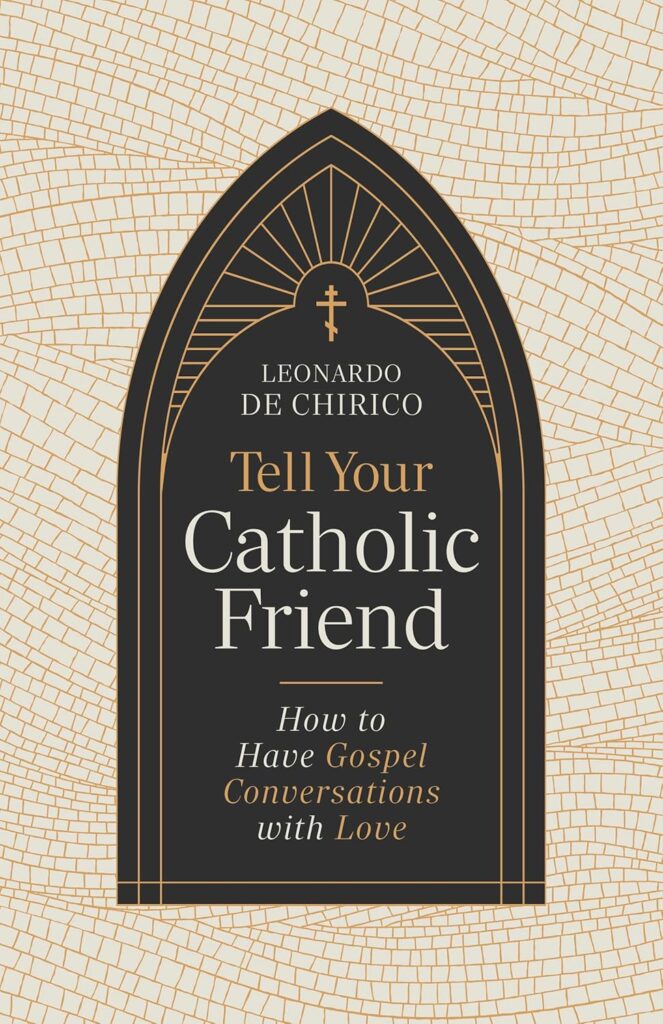
256. “Letter to Catholic Theologians.” I Am Not One of Them, But I Read it

I am not a Roman Catholic theologian, and so this letter is not addressed to me. As an Evangelical theologian, however, I am seriously engaged in trying to understand Roman Catholic theology, and so this letter interests me. I am referring to the Letter to Catholic Theologians (2026) by Monsignor Antonio Staglianò.
 
Bishop Staglianò is no ordinary voice in the landscape of contemporary Roman Catholic theology. He is, in fact, the president of the Pontifical Academy of Theology (PATH), whose mission is to promote dialogue between faith and reason and to deepen Christian doctrine following the indications of the Pope. 
 
Staglianò is also the author of books with titles as explosive as Pop-Christology or as evocative as Theology on One’s Knees (all titles are in Italian). He is a masterful orator who likes to quote Kant, Heidegger, and Hölderlin, and makes constant references to quantum physics and the ever-expanding frontiers of AI. During his years as bishop of Noto (Sicily), he attracted some attention for the pop culture references (songs, movies, etc.) that found their way into his homilies, shaped around what he called “pop theology.” In short, despite holding an institutional papal position, Staglianò is anything but a conventional thinker.

In this Letter, Staglianò summarizes what he has written extensively about in recent books and condenses it here into a few pages. It concerns his proposal to embrace what he calls “Christic Enlightenment” to overcome the dictatorship of the “Enlightenment Metaverse” and give theology a place in public debate and in people’s lives. His language may seem esoteric, but it is explained.
 
Staglianò begins with his interpretation of the current reality: Our age is no longer merely a time of secularization (positive, because it acknowledges pluralism), nor is it a time of secularism (negative, because it is ideological and antithetical to religions). We are in an era of de-Christianization, of de-culturalization, in which the symbols, beliefs, practices, and lived experiences of faith are being displaced and replaced by the blind algorithms of technology.
 
At the heart of the present-day crisis lies the loss of credibility of Christian Revelation, which is not considered worthy of being taken seriously; indeed, it is perceived as backward in thought and antagonistic to individual freedom. At best, it is relegated to the private sphere of belief but not to that of knowledge, which is the field of scientific reason only. The weight of the Christian narrative has evaporated.

For Staglianò, this cluster of oppositions to Christianity is called the “Enlightenment Metaverse”: a closed system of thought that denies Revelation and defies the knowledge of the faith it appeals to. According to Enlightenment dogma, “faith believes and does not know; reason knows and does not believe” (27).
 
In this context, there is no place for theology in public discourse; at best, it can aspire to cultivate a niche, secondary historical interest, without any epistemological claims beyond its own parched little garden. Indeed, for Martin Heidegger, the believer is incapable of thinking and must therefore step outside the modus credendi (i.e., the believing mood) if he is to be considered a voice worthy of being heard.
 
After his assessment of today’s challenge, here begins Staglianò’s pars construens. The “Enlightenment Metaverse” should not be countered by an impossible return to pre-modernity or a nostalgic recovery of Tradition (as Roman Catholic traditionalists would have it). The proposal is to usher in the era of “Christic Enlightenment.” Instead of playing defense, theology must move forward to overcome the Enlightenment challenge, i.e., by proposing an even greater and more demanding Enlightenment. “Christic” does not mean Christ-centered or Bible-focused. In Staglianò’s language, the allusion to Christ in “Christic” means greater, deeper, and wider than the Enlightenment project.

How? By practicing transdisciplinarity (thus becoming literate in the various languages and codes of knowledge), engaging in dialogue with everyone on the basis that everything is theion (divine), and developing the capacity for analogical imagination that can fertilize different categories (for example: the dual nature of Christ and the wave-particle complementarity of quantum mechanics). In doing so, an “unlimited space” (33) opens up in which theology rediscovers its public vocation and its epistemic power.
 
Staglianò claims to find inspiration from the intellectual lineage that stretches from Augustine, through Thomas Aquinas, and culminates in the 19th-century Roman Catholic theologian and philosopher Antonio Rosmini (38).
 
There are at least a couple of points that, upon reading the “Letter,” an Evangelical reader might suggest by way of commentary.
 
The first is that Staglianò’s reading of the “Enlightenment Metaverse” appears to be heavily influenced by the militant atheism of Richard Dawkins and Christopher Hitchens in Great Britain of the 1990s, which is now outdated. Not that the mainstream scientific community today is favorable toward theology or religions in general, but it no longer seems as oppositional and confrontational as Staglianò portrays it. Dawkins himself is favorable to “cultural Christianity,” which is considered a bulwark against hyper-technological nihilism and totalitarian Islam.

This is to say that the cultural dominance of the “Enlightenment Metaverse” is less evident, and its relationship with theology is more nuanced than the way Staglianò describes it.
 
The second point is that, however much it is expressed in lively, pop-culture language, Staglianò’s theological framework is the old Thomism rejuvenated by John Paul II in the encyclical Fides et Ratio (1998). According to this, faith takes on reason and science and elevates them by expanding their scope. It is the old Thomist project of integrating Aristotelianism and Christianity that Staglianò would now like to apply to scientism. As Thomas synthesized Aristotle and Christ, so Staglianò wants to befriend the Enlightenment and Christ.

This Thomist approach assumes the neutrality of reason and science and the possibility for them to be elevated to a superior level.
 
Staglianò rightly acknowledges that men and women are “religious beings”: The relationship with God, however much it may be denied or opposed, cannot be suppressed. This said, after the Fall, all of humanity is “broken” and corrupt, with no possibility of self-redemption. For this reason, reason must not simply be elevated or refined (i.e., the Thomist project), but radically redeemed by Christ (i.e., the Gospel mandate). Thus, the overall framework is not “nature-grace,” as Thomas and Staglianò would say, but “creation/Fall/redemption,” as the Bible teaches.
 
It seems, then, that Staglianò’s “Christic Enlightenment” is the latest version of the Thomist attempt to absorb reason and science into the Roman Catholic synthesis, without actually reforming much. A more promising path is to recognize Christ’s lordship over all reality (reason and science included), to take every thought captive to Christ according to Scripture (2 Corinthians 10:5), and to commit ourselves to the renewal of the mind (Romans 12:1-2).

255. A Year with Pope Leo. Evangelical Impressions

A gentle yet tough pope? A pope all about peace and dialogue? It is still too early to settle on a definitive assessment of Pope Leo XIV’s papacy. One year after his election (8th May 2025), however, it is possible to discern some key themes that confirm what was already evident at the start of his pontificate.

The global geopolitical landscape
Over the past year, the American pope has assumed a prominent “political” role on the global stage. It was predictable that the clash with Trump would erupt sooner or later, given the president’s combative temperament. And so it did. Preceded by Leo’s criticism of the handling of the deportation of undocumented migrants, the conflict with the U.S. administration erupted over the war in Iran. Trump has repeatedly criticized the pope, and the pope has responded in kind.

From someone like Trump, this was to be expected; less predictable was Leo’s decision not to rely on the soft-spoken ways of Vatican diplomacy, but to use direct communication to respond blow for blow. A talkative and casual pope like Francis used to make “free-wheeling” and sometimes unrestrained comments on current events; the surprise was that Pope Leo, too—despite his reserved and controlled nature—chose the unfiltered, “open-mic” approach to speak his mind.

In fact, for months now, the Trump vs Leo dynamic has dominated the global political narrative, casting the pope as Trump’s ultimate opponent in the name of “peace.” The gain in popularity, even among secular audiences, has been evident: in a world at war, who is against peace?

Meanwhile, with his trips to Turkey, Lebanon, and Africa, Pope Leo has confirmed contemporary Catholicism’s focus on the Global South, where the Roman Catholic Church is grappling with Islam and with growing evangelical churches. Following in Francis’s footsteps, he confirmed the offer of “dialogue” to the former and highlighted the bizzarre nature of the latter, while simultaneously emphasizing “Catholic” superiority.

The internal peacemaking line
Even within the Roman Catholic Church, Leo has acted in line with the reasons that led the conclave to elect him pope. Francis had left behind a church rife with internal conflicts and with the issue of “synodality” left confusingly unresolved. In this first year of his pontificate, Leo has not fanned the flames of division, but has sought to tone down the rhetoric, calm tempers, and maneuver in search of compromises.

With Catholic Germany calling for changes regarding the recognition of same-sex unions, he has maintained a firm stance without breaking with the more progressive factions. On the subject of synodality, he has tempered the zeal of the most ardent supporters, but has not dampened their enthusiasm. Regarding appointments to top positions in the Church, he has not yet made any radical or groundbreaking decisions, preferring to let the situation settle.

In short, on the domestic front, Leo has proven himself to be a seasoned and experienced political figure; a bridge-builder seeking to preserve the “integrity” of Roman Catholicism in the face of tensions, rather than a “prophet” heralding change or a “defender” of the status quo.

The ecumenical approach and relations with Evangelicals
In his first year of pontificate, Leo placed great importance on the ecumenical significance of the celebrations of the Council of Nicaea. He paid particular attention to the world of Eastern Orthodoxy and the Oriental Churches, with which the Pope’s Catholicism feels a growing affinity. Beyond institutional courtesy, he has been more reserved toward the liberal and ecumenical Protestant world. Proof of this is the bureaucratic reception he gave the Archbishop of Canterbury during her visit to Rome. The impression is that Leo’s ecumenical agenda looks more to the East (Orthodoxy) and to the South (Islam) than to the West (the traditional ecumenical world).

And what about the Evangelicals? They do not seem to be on Pope Leo’s radar, aside from a few indirect critical remarks between the lines of his speeches in Cameroon and Angola. Even during his previous tenure as bishop in Peru, he showed no particular interest in the Evangelicals. On the other hand, evangelicals around the world do not yet seem to have taken the measure of him. Unlike Francis, who boasted many evangelical friends in Argentina and beyond, Leo has not cultivated such relationships, with the result that the evangelical world remains distant and remote to him.

Meanwhile, his thinking, as expressed in his daily addresses, weaves together Augustinian themes (peace, grace, the Catholic experience), profound Mariology, and traditional Catholic teachings. His theological framework appears to be a Catholic Augustinianism reimagined from a post-Vatican II perspective.

254. Cradle of Tradition, Advocate for Multilateral Politics. The Roman Catholic Appeal To North America and Europe

The Roman Catholic Church attracts different people for different reasons. This simple fact has always been true. However, recent trends in global religious and political affairs are unfolding a new chapter of this old narrative. To put it in broad-brushed terms:
 
Rome attracts North Americans for the traditional outlook of its religious message and Europeans for its political stance in current world events.
 
In a nutshell, the former looks at the Catechism of the Catholic Church, i.e., the doctrinal and devotional teaching of Rome; the latter looks at the Social Doctrine of the Church (of Rome), i.e., the body of teaching especially about peace, dialogue, and international relationships, embodied by the Pope. Of course, this observation is over-simplified, but perhaps it contains an element of truth that is worth pondering on.
 
The Roman Catholic Appeal To North Americans
Over the last decade, there has been an increasing interest in Roman Catholicism in the USA. The phenomenon of conversions to Rome has triggered some attention. Numbers are not massive, but their social media impact is noticeable.
 
To some extent, Roman Catholicism has become a “cool” option in the public’s opinion, especially to those seeking to ground their religious experience in a historical, traditional, liturgical, and (perceived as) authoritative religion.
 
The impressive work of Roman Catholic apologists targeting Evangelicals has played a role in presenting Rome as the cradle of classical Christianity over against the alleged bizarre novelties and shallow performances of Evangelicalism. My conviction is that the credit that Roman Catholicism has in some circles reflects a selective view or a romanticized perception of Rome itself; ultimately, it lacks biblical warrant.

In a recent Master Class on “Why Some Evangelicals Are Tempted by Roman Catholicism and How to Respond,” I suggested five steps to come to terms with these facts:

  1. “Why Do They Cross the Tiber?”: Setting the Stage
  2. “To Be Deep in History Is to Cease to Be Protestant”: The Allure of Tradition 
  3. “Too Smart to Be a Protestant”: The Intellectual Attraction
  4. “Shallow and Consumerist Worship”: The Liturgical Challenge
  5. “Recovering Biblical Christianity”: The Antidote to Rome

I am not going to summarize all the talks here. The point to be underlined is that Rome’s appeal to North Americans is largely defined by an attraction to the intellectual tradition, liturgical sophistication, and institutional unity of Roman Catholicism that can be found in the teachings of the Catechism of the Catholic Church. It is the doctrinal and devotional outlook of Rome that people look for and conform their lives to.
 
In turn, this means that the challenge that Evangelicals perceive is primarily apologetic in the classical sense, e.g., facing Roman Catholic arguments on the biblical canon, the authority of Scripture, the papacy, Mariology, the sacraments, and salvation. Most North American Evangelical responses to the Roman Catholic appeal have tried to be apologetic in this sense. They do so by covering these traditional topics of the debate between Roman Catholicism and the Evangelical faith. While they address single issues with various degrees of competency, what is still lacking is an appreciation of Roman Catholicism as a system in which doctrines, practices, institutions, etc., are all integrated into a whole that is not committed to Scripture alone and to faith alone.

The Roman Catholic Appeal to Europeans
If we cross the Atlantic, we see a significantly different picture. Here, Roman Catholicism has a long tradition and, in some parts (e.g., Southern and Central Europe), is still the majority religion and a pervasive presence in society. However, the powerful blows of secularization have hit hard over the last fifty years. Roman Catholic buildings are everywhere, but they tend to be empty. Roman Catholic practice is low, and traditional identity-markers (e.g., processions, festivals) are blurred. Most people still consider themselves attached to a cultural form of Roman Catholicism, but their lifestyle is disconnected from the moral teachings of the Church.

While pockets exist here and there (e.g., in France and Great Britain) where adult baptisms have recently risen, the overall picture is bleak. Generally speaking, in Europe, there are few or no Roman Catholic apologists (as they can be found in the US) because there is little interest in what the Roman Church believes, and there is no wide-spread desire to embrace a fully orbed form of Roman Catholic doctrine and practice. The online presence is marked by the willingness to present Roman Catholicism as a religion of dialogue with all and inter-faith reconciliation. The main message of the still impactful educational institutions focuses on freedom, justice, beauty, solidarity, etc., with little direct connection to Roman Catholic dogmas and commitments. Belonging seems detached from believing, let alone behaving.

There is another side of the coin, however. In recent weeks and months, the centrality of the public voice of the Roman Catholic Church has regained some traction against the background of the rapid decline of the mood in the US-Europe relationships that used to be friendly but are now marked by tensions. The second Trump administration has exacerbated negative impressions by Europeans on the unpredictability of US foreign policy, e.g., tariffs, Greenland, and Canada. The US support for Israeli military operations in Gaza and Lebanon has fueled anti-American sentiments in significant portions of the European youth. Lastly, the US military intervention against Iran has been seen negatively by the European public opinion.

With the US losing its moral high ground gained during the Second World War, with the United Nations having practically disappeared from the scene, and with the European Union being disunited and disoriented, the only voice addressing global issues with a comprehensive perspective is that of the Roman Catholic Pope. Europeans resonate with Pope Leo XIV when he speaks about peace, reconciliation, immigration, multilateral dialogue, diplomatic efforts, solidarity among nations, respect for international law, and against war and exploitation. These are some of the themes of the Social Doctrine of the Church (SDC) that Vatican diplomacy strongly advocates for.
 
Now, European support and identification with the Pope stops when the Roman Pontiff speaks on other topics of the SDC, e.g., abortion, marriage, and euthanasia. Their secular mindset is far away, if not contrary to, the traditional moral teaching of the Roman Catholic Church. Not so with its social teaching applied to international politics and global issues.

In times of media polarization, the one who is resisting Trump and pushing back against the US international politics is the highest voice of the Roman Catholic Church. The Pope is seen as the global moral authority who speaks on behalf of peace, the migrants, and unity and against violence, war, and division. Europeans are attracted by this political and social face of Roman Catholicism, certainly not by its doctrinal and devotional message. 

The reality is that Rome is trying to fill the moral/social gap that secularization has left behind. The Roman Catholic Church has both the Catechism and the Social Doctrine. It has the doctrinal card and the social card to play. With the former, it attracts North Americans questioning Evangelicalism; with the latter, it appeals to secularized Europeans navigating a moral void. The two cards are played by the same Church that can handle different games at the same time.
 
In the European context, the Evangelical response to Roman Catholicism cannot simply rehearse the traditional apologetic points, e.g., justification by faith alone and the authority of Scripture, which are based on the doctrinal discourse. Of course, they are essential because they are the grounds of the theological commitments of the Christian faith. Yet in Europe, on the basis of these biblical pillars, Evangelicals need to develop a robust public theology that addresses issues of how the biblical worldview speaks into the social and political issues of our world. They also need to articulate them in a persuasive way by credible voices.  
 
This is to say that while the Evangelical interpretation of Roman Catholicism should remain anchored in Scripture and always aim to see Catholicism as a system, the strategies for addressing it may change according to context. In the present-day US context, the focus seems more doctrinal and devotional, whereas in the European context, attention should be given more to issues of public theology. 

253. Vatican II, 60 Years After and Two Lessons for Evangelicals

Why on earth is a religious event that took place 60 years ago still passionately debated? Most Evangelicals are puzzled when observing the theological and emotional involvement many Roman Catholics show when thinking about the Second Vatican Council (or Vatican II). Evangelicals may hold the 1974 Lausanne Congress on World Evangelization in high regard,[1] but their investment in discussing the texts and the spirit of the Lausanne Movement is only remotely comparable to the heat generated by the legacy of Vatican II in Roman Catholic circles.
 
Vatican II: Great Grace or Cause of all Problems?
On the one hand, it was no less than Pope John Paul II who bluntly stated that Vatican II is “the great grace bestowed on the Church in the twentieth century: there we find a sure compass by which to take our bearings in the century now beginning.” (Apostolic Letter Novo Millennio Ineunte, 2001, n. 57). On the other, there are sectors of the Roman Church that are cold toward the Council, if not critical of its outcomes. The issue of what Vatican II means for Roman Catholicism is still at stake.
 
Since the beginning of January, Pope Leo XIV has been focusing on the main texts produced at the Council in his Wednesday morning General Audiences given in St. Peter’s Square. In so doing, he is signaling the permanent relevance of the Council for the Roman Catholic Church and providing his own interpretation of it.

Meanwhile, the theological discussion on Vatican II goes on relentlessly. One of the recent contributions from a group of Italian Roman Catholic theologians is the collection of essays edited by Marco Vergottini, Al cuore del Vaticano II. Una rilettura teologico-fondamentale (Brescia: Queriniana, 2026; English translation: At the heart of Vatican II. A theological-fundamental re-reading).
 
In its four chapters, the book opens some windows on the most important documents, i.e., the four constitutions on divine revelation (Dei Verbum), on liturgy (Sacrosanctum Concilium), on the church (Lumen Gentium), and on the church in the modern world (Gaudium et Spes).
 
More than touching on the details of each chapter, what is interesting is to appreciate how the whole reception of Vatican II is framed, especially as far as the “heart” of the Council and its significance for the present-day Roman Catholic Church is concerned.
 
Beyond the Conflict of Interpretations
Here is the gist of the reflection echoed in the book. The aftermath of Vatican II has been characterized by an ongoing conflict of interpretations. After the first phase, when the texts of the Council were commented on in the context of a very positive attitude towards them and in view of the application of its deliberations, later decades have seen the emergence of a critical reading of the Council, sometimes presented as a “rupture” from the established tradition. Examples of this tendency can be found in the five-volume History of Vatican II edited by G. Alberigo, 1995-2001, and the five-volume Herders theologischer Kommentar zum Zweiten Vatikanischen Konzil edited by P. Hünermann and B.J. Hilberath, 2004-2006.

This reading, which stressed the discontinuity between Vatican II and the pre-Vatican II Church, was opposed by an anti-conciliar sentiment that spread in traditionalist circles. In their eyes, Vatican II was seen in negative terms and as the cause of all problems. Other interpretations wanted to read Vatican II in merely pastoral terms, as if the Council wanted to update the language of the Roman Church and build bridges with the modern world, but not change its doctrinal posture and traditional practices.
 
The tension (at times, the chaos) generated by these discussions led Benedict XVI, in his 2005 Address to the Roman Curia, to move beyond polarization by suggesting a mediation in the “hermeneutics of reform” formula. In pure Roman Catholic style, the two extremes (i.e., discontinuity and continuity) were questioned and replaced with a dynamic category of renewal within the tradition that would account for the developments of the Council while remaining committed to the dogmatic outlook and the self-understanding of the Roman Church inherited from the past.
  
Vatican II as an “Open” Structure
The book wants to highlight the strategic importance of this dynamic principle both in the drafting of the documents and in their subsequent reception, whereby updating and fidelity are not to be pitted one against the other, but combined in a Roman Catholic, organic way.
 
Looking at Dei Verbum in particular, here is how it works: Vatican II absorbed some fundamental principles of the two previous Councils (i.e., Trent and Vatican II), yet wanted to overcome their controversial and apologetic thrust (p.60). In the words of Vatican II itself, “sound tradition” must be retained, and yet “the way remain open to legitimate progress” (Sacrosanctum Concilium, n. 23). 

As far as the Church is concerned, the inherited rigid vision of the Church as the hierarchical perfect society is reiterated, yet expanded to include the importance of the laity in the logic of an ecclesiology of communion rather than mere obedience. In this sense, Vatican II adopted an “open structure,” no longer driven by the desire to separate and divide that was prevalent in past Councils, nor by the impulse to compromise between traditional and progressive positions. Rather, it was guided by the power of navigating “between” polarities.  
 
The Roman Catholic move is not an attempt to choose between positions, but to connect them according to the principle of “hospitality” (p. 164) guaranteed by the Roman Catholic conciliar dynamic system.
 
Two Lessons
What can Evangelicals learn from these Roman Catholic debates? At least a couple of points should be mentioned.
 
First, Evangelicals need a better grasp of what happened at Vatican II, what was produced then, and how it has been received in the Roman Catholic Church. In the past, much attention has been given to Trent (and rightly so), but less attention has been paid to Vatican II. Today, many Evangelicals can be confused about what is going on in Roman Catholicism because of a lack of awareness over the last 60 years. Developing an Evangelical analysis of Vatican II is still a work-in-progress, and homework needs to be done. The danger is to have either outdated, static views of Rome or unwarranted, evangelically hopeful perceptions of it. As the book indicates, Rome evolves in history while remaining committed to itself. Becoming acquainted with the different Roman Catholic voices discussing the legacy of Vatican II is a step forward toward a more theologically mature Evangelical interpretation of it.

 
Second, as intuitive as it may sound, the “Traditional vs. Progressive” grid does not fully fit the reality of Roman Catholicism. It probably fitted the “Conservative-Liberal” divide within 20th-century Protestantism, but it does not neatly apply to Rome. Roman Catholicism has its own way of handling its movements through history. Yes, there are traditional voices, yes, there are progressive tendencies, but the overall direction is not driven by the polarization between the two. One needs to come to terms with the dynamics of the Roman Catholic system that is Roman (i.e., faithful to its centered structure) and Catholic (i.e., open to ongoing absorptions) at the same time.
 
Since the biblical Gospel is not the ultimate criterion, the Roman Catholic system is governed by its self-defined Tradition (which swallows the Gospel and does not submit to it) and can oscillate between the Roman and the Catholic poles. Instead of applying the “Traditional vs. Progressive” opposition in a simplistic way, Evangelicals should study the inner dynamics of Rome that allows it to change but not reform itself according to Scripture.


[1] E.g., The Lausanne Movement: A Range of Perspectives, edited by Lars Dahle, Margunn Serigstad Dahle and Knud Jørgensen (Oxford: Regnum Books International, 2014).

252. Sacred Bones? Why Roman Catholicism Needs Relics

The blood of Saint Januarius in Naples. The tongue of Saint Anthony in Padua. The head of John the Baptist in Rome. The tail of the donkey ridden by Jesus in Genoa… Welcome to the imaginative world of Roman Catholic relics. Many Catholic churches hold relics of various kinds and origins that have been venerated for fifteen centuries.

As material objects, relics are fragments of bones, limbs (arms, legs, fingers), organic tissues and textile fabrics, and various objects that belonged to figures from the Gospel or church history to whom the Roman Catholic Church attributes a role in pointing people to God. Since these objects come from or have been in contact with “saints,” they are considered capable of transmitting a sense of divinity or holiness to those who venerate them (by going on pilgrimage, touching them, or praying in front of them).

This is how Rome explains the reason for relics: “Relics in the Church have always received particular veneration and attention because the body of the Blesseds and of the Saints, destined for the resurrection, has been on earth the living temple of the Holy Spirit and the instrument of their holiness, recognized by the Apostolic See through beatification and canonization.” [1]

A new and fascinating book by historian Federico Canaccini, Sacred Bones: Stories of Relics, Saints and Pilgrims (Italian edition: Sacre ossa. Storie di reliquie, santi e pellegrini, 2025), tells the history of how objects and bones became religious relics.

The question that prompts the book is the following: If the Christian faith starts from the empty tomb of the risen Lord Jesus, why has Roman Catholicism filled its churches with objects to be venerated?
 
If the Christian faith relied on the eyewitness testimony of those who saw the risen Jesus and then wrote the books of the New Testament as “proof,” why did the Christian masses go in search of artifacts to help them believe?
 
If apostolic teaching says that “we walk by faith, not by sight” (2 Corinthians 5:7), why has Roman Catholic imagery filled itself with things to see, touch, and kneel before?
 
The book shows how the “Constantinian shift” of the fourth century changed the face of Christianity by adding the collection and veneration of relics to Christian spiritual practices. After Constantine became emperor, his mother, Helena, organized an expedition to Jerusalem to search for objects and artifacts related to the history of Jesus with which to fill the temples that were being built throughout the empire.

From that expedition, Helena brought back the wood of the cross, the nails of the crucifixion, hairs from the Lord’s beard, etc., effectively “creating” the phenomenon of Christian relics and introducing into Christian life the idea that they were “charged” with holiness that could be transferred to the faithful.

The phenomenon of relics thus arose during that complex and sadly decisive transformation of Christianity from its post-apostolic phase (still largely anchored in biblical teaching) to its “Roman” phase. It was a transition in which Greco-Roman religious beliefs were covered with a Christian veneer, rather than being challenged by the Gospel and reformed accordingly.
 
Instead of following the words of the Lord that “blessed are those who have not seen and yet have believed” (John 20:29), the Christianity of relics changed the rules of engagement of faith: From listening to the Word to viewing objects, from the mediation of the risen Lord Jesus to that of saints and other mediators, from the presence of the Holy Spirit to the touch of artifacts.
 
Canaccini’s book is a fascinating journey through the history of relics and documents how, from Helena onwards, Roman Catholicism was swept up in a frantic search for relics, to the point of becoming a factory for them. The author also appropriately reports the devastating criticism of the Protestant Reformation (above all, John Calvin, who wrote a “Treatise on Relics” in 1543), which contested not only the abuses associated with relics but also their biblical legitimacy.
 
Canaccini seems to understand Protestant criticism but remains within the narrative of relics as fulfilling a deep anthropological need—that of contact with the sacred through an object considered close.

Here, there is a fundamental choice. Roman Catholicism chooses to accommodate its religious offer to the quest for tangible objects mediating the sacred. In theological terms, Rome integrates grace into nature, elevating it to a supernatural level. From this perspective, relics are felt as a necessity of nature, and grace responds to the need for contact with the divine through the relics of saints. This happens in analogy to the way Roman Catholicism believes that the Eucharist is the “real” presence of Christ, whereby the bread and the wine are transubstantiated (i.e., the nature is changed into the body and blood of Christ).
 
Roman Catholicism understands grace as being transmitted by means of objects (wine, bread, oil, water, sanctified altars, relics, etc.) that are “sacraments” or “sacramentals”. Relics are among those graced “objects” that can administer grace as part of the sacramental system.  
 
The Evangelical faith is different; based on Scripture, it knows that “faith comes from hearing the Word of God” (Romans 10:17) and that faith is “the assurance of things hoped for, the conviction of things not seen” (Hebrews 11:1). It also believes that “by grace we are saved through faith” (Ephesians 2:8). Jesus Christ is truly present through the Holy Spirit in the signs He left behind (baptism and the Lord’s Supper), but not in objects imbued with the divine.
 
Ultimately, the choice is between religious anthropology filtered through Greek thought and cloaked in Christianity, i.e., the Roman Catholic option, or the biblical Gospel that renews one’s entire life, i.e., the Evangelical option. Relics are the symbol of the former, not the latter.


[1] Instruction “Relics in the Church: Authenticity and Preservation” (2017) issued by the Congregation for the Causes of Saints.