“You are the light at the end of the tunnel.” This is how Polish sociologist Zygmunt Bauman (1925-2017) addressed Pope Francis during their meeting in Assisi in 2016 on the sidelines of a Sant’Egidio (i.e. a Roman Catholic charity) peace initiative. In his conversation with Francis, Bauman said, “I have worked all my life to make humanity a more hospitable place. I arrived at the age of 91 and I have seen many false starts, until I became a pessimist. Thank you, because you are for me the light at the end of the tunnel.”
How did the sociologist most known for his books on the “liquid society” happen to see the “light” in the Pope? The book by Zeger Polhuijs, Zygmunt Bauman and Pope Francis in Dialogue: the Labyrinth of Liquid Modernity (Lanham, MD: Fortress Academic, 2022) examines the long-distance intellectual relationship between the two. Polhuijs is a Roman Catholic priest of the Community of Sant’Egidio and currently studies fundamental theology at the Pontifical Gregorian University in Rome. The book was presented at the Roman campus of the Australian Catholic University on 28th November 2023 and allows more digging into the matter.
Bauman’s attraction to Pope Francis is an episode that shows an interesting and widespread tendency in contemporary culture: how post-Marxist intellectuals, disillusioned by the failures of ideologies and preoccupied with the explosions of world fragmentation, find in Pope Francis a figure who, with his message of mercy, inclusion, and fraternity, instills hope in the general dullness.
Returning to Polhuijs’ book, it highlights how, in his examination of the ills of the contemporary world, Francis uses Bauman’s language and, conversely, the sociologist’s analyses overlap with the pope’s. There is a certain parallelism between them. Bauman, an agnostic, Jewish, post-Marxist, was attracted to Francis’ open and concrete thinking and the “transcendence” of the human fraternity he presents. In it, Bauman sees the awareness of the danger of the globalization of indifference, which is an effect of the liquid society, disengaged from traditional values and which has lost all sense of proximity. The antidote to liquidity is not a nostalgic and definitively lost solidity (Francis would call it “backwardism,” “clericalism,” “proselytism”), but solidarity among all: believers and non-believers. To contrast the adverse effects of liquid society, one does not need a common reference to God, but the appreciation of human fraternity.
For Bauman, Francis embodies this: not a reactionary religious voice saying to go back to traditional society or the Catholic church as the only agency that grants happiness for the afterlife, but an encouragement to connect with everyone by discovering the closeness of solidarity, regardless of one’s beliefs, religious commitments, or life practices. “The light at the end of the tunnel” is a new form of humanism that Francis seems to champion.
The proximity between Bauman and Pope Francis was indirectly observed by the conservative American intellectual George Weigel when he coined the term “liquid Roman Catholicism” as a description of the kind of Roman Catholicism that is emerging under Francis. Liquid Catholicism is marked by the uncertain teaching on doctrinal and moral subjects of primary importance; a kind of intolerance towards the pre-conciliar liturgy; the constant pickaxing of the Roman Catholic institution with repeated criticism of clericalism; the ways the Pope acts outside the box that destabilize customs; the welcoming and merciful message at the expense of the doctrinal and moral requirements of the Catechism of the Catholic Church, etc. All of this makes Francis a pope who is liquifying an institution that in the past has made its rocky and immutable structure a distinctive trait of its identity.
Liquid Catholicism embraces believers, non-believers, Christians, non-Christians, practicing and non-practicing religious people. The important thing is that all are included. Everyone, in his or her own way, will decide the ways and times of their participation, but the assumption is that everyone is already a participant. Not surprisingly, Roman Catholics accustomed to thinking of their Church in terms of doctrinal clarity, unambiguousness of interpretations, and predictability of practices are puzzled by Pope Francis.
The point I want to make is this. In Bauman’s attraction to Francis, he was not interested in God, the Bible, sin, Jesus Christ, and salvation; the sociologist remained agnostic and did not convert to Roman Catholicism or the Christian faith. He was interested in society’s degradation, for which the recipes of ideology advocated in his youth had proved unsuccessful. On the other hand, Francis did not challenge him to believe in God, just as he does not confront his interlocutors with the need for biblical conversion. The Pope encourages them and all to feel that they are “all brothers,” to welcome each other, to consider fraternity the source of transcendence, leaving each to regulate his relationship with God in his own way, should he be interested.
This kind of “catholicity”, i.e. liquid Catholicism, pleases the post-Marxist culture, which, from being anti-religious and atheistic, has now become agnostic, perhaps indifferent to the discourse about God, but still characterized by its humanitarian concerns. This is the common ground with Francis’ catholicity. It makes the pope a “popular” figure in the eyes of progressive culture because it grounds transcendence on horizontal relationships (God is not needed), exalts fraternity among fellow human beings (reconciliation with God is not sought), and encourages proximity with one another (without fellowship with God). It bypasses Jesus Christ who said: “I am the light of the world” (John 8:12). Biblically speaking, then, is what Bauman found in Pope Francis the true light at the end of the tunnel, or is it instead not another shade of darkness?
223. The Icing on the Cake of Pope Francis: the Blessing of Same-Sex Unions
The Roman Catholic Church officially opens for the blessing of same-sex unions. After much winking and hinting that this would be the outcome of the current pontificate, the official statement came out, putting pen to paper. “One should neither provide for nor promote a ritual for the blessings of couples in an irregular situation. At the same time, one should not prevent or prohibit the Church’s closeness to people in every situation in which they might seek God’s help through a simple blessing” (n. 38). So says the declaration Fiducia supplicans (18/12/2023) by the Congregation for the Doctrine of the Faith, with explicit approval from Pope Francis.
The die is cast. What had been a decade-long debate between those who hoped for this opening, considering it an advancement of Catholic morality toward greater inclusiveness, and those who saw it as a sign of Roman Catholicism’s irreversible ruin is now resolved. With a “declaration” of high hierarchical value in the authority of Vatican pronouncements (observers note that the Congregation’s last statement was Joseph Ratzinger’s Dominus Iesus dating back to 2000), Roman Catholicism is now officially in favor of blessing gay unions, as are many liberal Protestant churches around the world.
It all began with “Who am I to judge?” (2013) to “All, all, all” at the Lisbon Youth Day (2023). The trajectory was clear from the start: Pope Francis’ inclusive, embracing, “Catholic” afflatus and his distance from positions that he calls “clerical” and “backwardism” but that are also part of the doctrinal baggage of Roman Catholicism. In between are many steps, not the least of which is the appointment of trusted Argentine theologian Víctor Manuel Fernández as Prefect of the Congregation for the Doctrine of the Faith, who signed the Declaration. Now Francis has his back covered even within the Vatican’s “official” theology. Indeed, Fiducia supplicans openly contradicts another 2021 document of the same Congregation, when Cardinal Ladaria was Prefect. Then, responding to “doubts” precisely about the possibility of blessing same-sex unions, the Vatican had still responded with a (somewhat) clear “no.” Two years later, however, the answer is “yes.” Evidently, the evolution toward Roman Catholic inclusion has accelerated further.
Of course: the Vatican says that there is no question of recognizing gay unions as marriage, that Catholic doctrine does not change, that the blessing is not a sacrament but a sacramental, … all secondary doctrinal clarifications that do not modify the main point. The Roman Catholic Church today officially offers blessing to same-sex couples: something, moreover, already in place (and for years) in Roman Catholic churches in many European (e.g. Germany and Belgium) and Latin American (e.g. Argentina) countries.
Roman Catholics must ask themselves whether Fiducia supplicans is consistent with the previous magisterium or is in open conflict with it. By its nature, Roman Catholicism is constantly on the move to possibly encompass the whole world within the institutional-sacramental structures of its Roman system. Not being hinged on and guided by the biblical gospel, Roman Catholicism fluctuates between asserting its Roman power and accentuating its Catholic embrace. In Dominus Iesus (2000) the Vatican restated its Roman understanding of the Catholic Church being the only and true church. With Fiducia supplicans (2023), the Vatican opens its Catholic embrace to same-sex couples.
Fiducia supplicans is the icing on the cake of his pontificate. The main ingredients of Francis’ Jesuit recipe have been two: we are “all brothers” (Christians, non-Christians, atheists and agnostics: everyone) and the Catholic Church is the “field hospital” for all. Now, there is also the icing on the cake.
Fiducia supplicans is in open contrast to biblical teaching. Pope Francis is a shrewd Roman Catholic Jesuit who leads his church toward the most “catholic” form it has ever had, but not toward the gospel of Jesus Christ.
222. From “Metaphysical” to “Popular”: A Window on the Roman Catholic Theology of the Future?
In the beginning was Roman Catholic metaphysics: Aristotelian in outline, revisited and improved by Thomas Aquinas, capable of integrating some biblical and Augustinian insights, elastic to the point of metabolizing mystical and rationalistic streams, open to updating with respect to modernity, while maintaining its solid structures. Metaphysics was taught in Roman Catholic seminaries (two years of metaphysics preceded the study of theology in the training of priests). It was at the heart of catechesis, the watermark of the church’s documents, and the imprint of its public morality and theology. In short, it was the recognizable mark of the Roman Catholic church. Metaphysics started from “first principles” and, in the light of reason as helped by revelation (coming from Tradition and the Bible), by deductive means and procedures, arrived at every nook and detail of human life. With this metaphysics, Rome fought against the Protestant Reformation, the Enlightenment, and modernism.
Then came Vatican II (1962-1965), and that solid framework was stress-tested. It went through a season of development and updating, introducing a new set of emphases. The “pastoral” tone was preferred to the “doctrinal” one. The top-down structure made room for more bottom-up processes. The season of “genitive” theologies (of demythologization, enculturation, hope, liberation, post-colonialism, ecumenism, inter-religious dialogue, etc.) battered classical metaphysics. In the name of “renewal,” there was a certain theological restlessness and an eagerness to change the paradigm.
Then there was Pope Francis (2013- ). Of eclectic and unfinished theological training, Argentine and non-academic, the pope immediately showed his frustration with the schematism of metaphysics, denouncing its abstract and “clerical” character, in his view far away from people’s problems and offering answers to questions of the past that nobody is asking. In their own way, the “outgoing” trajectory of which he became an interpreter and the “synodality” he championed are formulas that apply to theology as well. In concrete terms, in 2018, with the Constitution Veritatis Gaudium, the pope sent signals to the ecclesiastical universities, preparing them for a new season. After the death of Benedict XVI, Francis changed the leadership of the Congregation for the Doctrine of the Faith, giving it to a “non-metaphysical” theologian like Víctor Manuel Fernández. Now, with the document Ad theologiam promuovendam (“Promoting Theology”, 1st November 2023; Italian text; English unofficial translation), he changed the statute of the Pontifical Academy of Theology, which is a Vatican institution at the service of the pope’s theological ministry. In this text, Pope Francis envisages his way of doing theology.
In imagining the Academy of the future, Francis hopes that theology will experience an “epistemological and methodological rethinking,” a “turning point,” a “paradigm shift,” a “courageous cultural revolution.” In the background is dissatisfaction with traditional metaphysics and its theological methods. According to Francis, theology must be “fundamentally contextual” and no longer start from “first principles.” It must translate into a “culture of dialogue” with all and no longer think of itself as only lecturing to the world, religions, and others. It must be “transdisciplinary” and no longer prioritize philosophy over the other disciplines. It must be “spiritual” and not abstract and ideological; “popular” and not detached from people’s common sense; “inductive” and not deductive.
In so doing, the pope distances himself from the legacy of metaphysical theology that has been the paradigm of Roman Catholicism throughout the ages. Is his way of looking at theology something that Thomas Aquinas, Robert Bellarmine, Leo XIII, John Paul II, Joseph Ratzinger-Benedict XVI, etc., would recognize as being in line with the tradition of Rome? Not really. Perhaps Karl Rahner, some Liberation theologians, and their disciples would.
“Promoting theology” seems to be a manifesto of an account of Roman Catholic theology that, without naming traditional metaphysics, distances itself from it in significant ways. It does not appear to abolish metaphysics by decree but subjects it to accelerated “updating” and “development” such that its connotations are changed. In a nutshell, the Roman Catholic theology of the future will be done differently.
As noted at the outset, traditional metaphysics has absorbed all the orientations that have emerged, even those that initially seemed contrary to its arrangement. It has demonstrated great adaptability at the service of Roman catholicity, i.e. the ability to integrate new ideas and methods without changing the fundamental commitments of the Roman Catholic church. The question is: is the direction Francis wants theology to take compatible with its well-established patterns? Is it a radical change with unpredictable consequences? For sure, in the wake of Vatican II as interpreted by Francis, Roman Catholic theology will be increasingly different not only in emphasis but also in language, style, themes, and content. Those who think of Rome as the home of stability have yet another indication that Rome does develop and change. Tradition is an evolving process.
It is feasible to say that the Roman Catholic theology of the future will be et-et, both-and: both the one established over the centuries and the one Pope Francis desires. Both approaches to theology are not committed to Scripture as the supreme authority. The former reflects a philosophical system rather than the Bible; the latter mirrors the context more than the Word of God. In both cases, theology is hardly evangelical but rather two ways of voicing Roman Catholic theology: one more “Roman” (metaphysical), the other more “catholic” (contextual).
221. Should Evangelicals Pray with Roman Catholics?
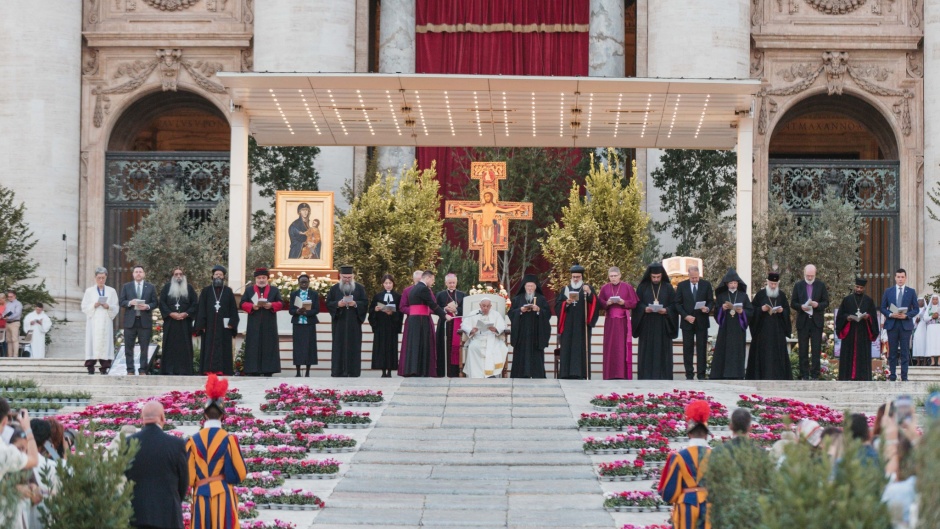
As I speak at conferences on Roman Catholicism worldwide and how Evangelicals should relate to it, a question often arises: “What about joint prayer? Could or should Evangelicals pray with Roman Catholics?” Let me offer my rules of thumb as I wrestle with the issue.
1. The Bible is clear that we should pray for all men and women (e.g. 1 Timothy 2:1), so praying for those friends, colleagues, and family members who are Roman Catholics is mandatory. There is no doubt that praying for Roman Catholics is a God-given responsibility for all evangelicals.
2. The issue becomes critical when discussing praying with Roman Catholics. Praying with someone is a spiritual activity that presupposes the existence of spiritual bonds, i.e. fellowship in Christ. In other words, prayer with someone is legitimate when the people praying together are brothers and sisters in Christ, joining their hearts and voices to praise the Triune God and intercede for various topics in the name of Jesus Christ. Here comes the first problem: according to Roman Catholic doctrine, one becomes a Christian at baptism, normally received when the person is a newborn. It is the sacrament of baptism that makes the person a Christian. For the evangelical faith, one becomes a Christian at conversion when the person believes the gospel of Jesus Christ. The turning point is not the reception of the sacrament (the Roman Catholic view), but personal faith resulting in a transformed life (the biblical view). The reality is that a Roman Catholic person might have received the sacrament of baptism, but she/he is not a believer in Christ in that she/he was never converted. If this is the case, she/he is not a sister/brother in Christ and therefore there is no spiritual bond in Him making it possible to elevate our joint prayers to God. If we pray together, we are saying that we are united in Christ, but since this is not the case, joint prayer should be avoided and practiced with converted people only. This is my daily experience with my Roman Catholic neighbors: most of them were baptized by the Roman Catholic Church but show no evidence of any spiritual life biblically understood. I cannot relate to them as “brothers and sisters.” While I gladly pray for them, I don’t ask for their prayers, nor do I pray with them on the assumption that we are “brothers and sisters” in Christ since we are not.
3. Another aspect that makes common prayer impossible is that Roman Catholicism believes in a different account of the gospel than the biblical one. There are some overlaps in language but fundamental differences in basic truths of the gospel, e.g. the ultimate authority of the Bible in all matters of faith and life and salvation by faith alone. From these different commitments arise contrasting appreciations of the gospel. For example, as far as prayer is concerned, because Scripture is not the ultimate standard and we are thought of as contributing to our salvation through the merits of the saints, Roman Catholicism prescribes prayer to the saints and Mary as intercessors. These are not biblically warranted practices. The Catholic faithful are taught that they can pray to Mary and the saints for their petitions, not to Jesus Christ alone. If you pray with a Roman Catholic, you may use similar words but express different faiths. It is better to avoid generating confusion and ambiguity and respectfully abstain from joint prayer if the people involved have yet to give signs of being converted to Christ. The fact that they are Roman Catholics does not mean they are “brothers and sisters” in the faith.
4. I don’t deny that there are Roman Catholics who are genuinely converted. God’s grace is at work in men and women who trust in Jesus Christ alone for their salvation and desire to follow the Word of God. However, these people have a problem with their Roman Catholic identity. If they follow Christ alone according to the Bible alone, they are inconsistent with their alleged Roman Catholic faith. They may be believers in the biblical sense, but they are inconsistently Roman Catholics. While encouraging one another to grow in our faith, even if this means questioning Roman Catholic beliefs and practice, if they are converted to Jesus Christ and not simply baptized, we can pray with them in private settings characterized by informality.
5. I abstain from participating in joint prayer in public settings and events. Apart from the reasons above (# 2 and 3), another consideration must be made. Once you pray with someone in public, you are conveying that all the participants share the same Christian faith and are “brothers and sisters” in Christ. All existing differences are but footnotes that do not impede biblical fellowship. Because the Roman Catholic account of the gospel is flawed, if we participate in public joint prayer, we accept it as a legitimate version of the true gospel, with minor concerns over secondary issues: this is the symbolic message that comes from public prayers with Catholics. This is even more true when the people we pray with are Roman Catholic priests. If we pray in public with them, we recognize that the Church they belong to and the account of the gospel it promotes are biblical expressions of the Church and sufficiently faithful appreciations of the gospel. It is essential to pay attention to the power of symbols. “Ecumenical” gatherings that include joint prayers want to affirm that all participants recognize one another as “brothers and sisters” in Christ and their respective communities as legitimate expressions of the biblical church.
6. In European ecumenical circles, many joint prayer events are organized around the Week of Prayer for Christian Unity (18-25 January each year) by the Roman Catholic Church and the World Council of Churches. Their view of the gospel and unity is based on the sacrament of baptism (see # 2) and not on personal conversion to Christ. The symbolic message that this initiative wants to promote is that all Christians, despite the denomination and tradition they belong to, are “one,” “united” as “brothers and sisters.” Since this is not the case, I don’t participate in it. While I am willing to engage in dialogue with Roman Catholics at all levels, I consider joint prayer to be the privilege of born-again Christians and not necessarily members of ecclesiastical bodies.
220. “The next Pope will be John XXIV.” Will he?
“On the Vietnam journey, if I don’t go, John XXIV certainly will.” In the traditional inflight press conference on the papal plane returning to Rome from Mongolia (September 4), Pope Francis hinted at his possible successor. Being asked what his plans are for future international journeys, Francis showed awareness of his frailty, due to age and poor health conditions. This is why he cannot plan long-term. He also indicated the name of a possible successor who could replace him after he is gone. Of course, he did not refer to a specific individual, but to the papal name he wished the next Pope could take.
The indication of the name “John XXIV” sheds light on the preferred portrait of the pope of the future. It is worth noticing the possible names he did not refer to and the one he used during the interview.
“Francis II” was not mentioned for understandable reasons. A reigning Pope wishing his successor to follow his steps is legitimate, but indicating that he should choose his name would have been an abnormal form of egocentrism. In his 10-year tenure, Francis has shaped the next conclave (i.e. the assembly of cardinals who will elect the next Pope) by nominating 70% of it. Most of the new cardinals are Francis’s friends and like-minded people. Obviously, he wants the successor to follow in his footsteps, but wishing him to take the name “Francis II” would have been a faux pas.
“Benedict XVII” wasn’t mentioned either. Despite formally polite co-existence, Francis has always thought of himself as breaking off the ecclesiastical trajectory of Pope Ratzinger. There has been a cleavage between the two on all grounds: doctrine, practice, style, language, strategy. After the death of Benedict XVI, Francis tried to limit his influence and close his era. Certainly, Francis does not want Pope Ratzinger’s staunchly “Roman” and traditional line to be revived after the end of his reign. He believes there is no place whatsoever for a “Benedict XVII” in the future of the Roman Catholic Church.
Furthermore, a “John Paul III” was not indicated as a desirable follow-up. John Paul II’s legacy is surely tied to the re-launching of Rome’s catholicity (i.e. the embracement of the world into Rome’s sacramental and institutional structures) – something that Pope Francis is also pursuing in his own way. However, John Paul II (now a “saint”) was also the Pope who engaged in “culture wars” with the secularizing West, upholding traditional Roman Catholic moral identity-markers (e.g. opposition to abortion, euthanasia, and homosexuality). He created an “us” versus “them” mentality in the relationship with the world, especially the secular West. This oppositional posture is very far from Pope Francis’s more “catholic” and inclusivist strategy. He wants to underline that we are “all brothers” and continue to be so despite professing different religions and having opposite ethical convictions. Francis does not want the Roman Church to be a polarizing agency but a place where differences exist in harmony.
“Paul VII” did not appear to Francis as a desirable successor either. While Francis often positively quotes Paul VI as the one who wrote the encyclical Evangelii Nuntiandi (1975) calling the Roman Church to engage in “evangelization” (to be understood in the Roman Catholic sense of expanding the borders of the Roman Church), he apparently dislikes the black and white picture that Paul VI painted in dealing with moral issues such as the regulation of birth in his encyclical Humanae Vitae (1968). Paul VI created a chasm between the world and the Church. On the contrary, Francis wants to eliminate all separation and treats differences, even the sharpest ones, as instances of human richness to be harmonized.
Neither “Francis II,” “Benedict XVII,” “John Paul III,” nor “Paul VII.” Why “John XXIV” then? Here are some possible explanations for why Pope Francis would like his successor to imitate or look like John XXIII. John XXIII is known as the “good pope” who was approachable, kind, warm, and humble. Giuseppe Roncalli (1881-1963), John XXIII, was the Pope who convened the Second Vatican Council in 1959. The Council only began in 1962, and John XXIII died during it. Vatican II is the watershed event in the present-day Roman Catholic Church whereby Rome began to downplay its centuries-long insistence on the “Roman” sides of its identity (e.g., hierarchy, full adherence to the catechism, submission to the ecclesiastical authority) and to stress its “catholic” aspirations (e.g., inclusion, embracement, absorption). Francis thinks of himself as enacting and implementing this aspect of Vatican II.
Moreover, in the opening address to Vatican II, John XXIII remarked that the Council had no doctrinal agenda but wanted to develop “a magisterium which is predominantly pastoral in character.” Neither condemnations of the world nor theological definitions were to be expected. What ensued was a wholehearted affirmation of the goodness of the modern world. Francis likes to underline the pastoral nature of everything the Church says and does. The pastoral dimension (warm, welcoming, accepting of all) is often referred to as if it were in opposition to the doctrinal one. Francis thinks of his pontificate as a “pastoral” attempt at building bridges instead of creating walls with the whole world, leaving doctrinal issues aside. He wants this “pastoral” emphasis to be kept and even increased by his successor. A John XXIII-like pope is expected to promote universal fraternity in ecumenical, inter-faith, and social relationships.
A final comment is in place. Unlike John Paul II, Benedict XVI, and Francis, John XXIII was an Italian pope. Among the candidates to succeed Francis, Cardinal Matteo Zuppi, the Italian archbishop of Bologna and president of the Italian Bishops Conference, is at the top of the list. In recent months, Francis sent Zuppi to visit Ukraine, Russia, the US, and now China as his ambassador for peace in the Ukraine war. In so doing, he wanted to raise Zuppi’s international profile. In many ways, Cardinal Zuppi resembles the portrait of “John XXIV”: not known for his strong doctrinal views, but recognized as a cardinal dedicated to dialogue, peace, and fraternity. Did Pope Francis intend to indirectly campaign for him?
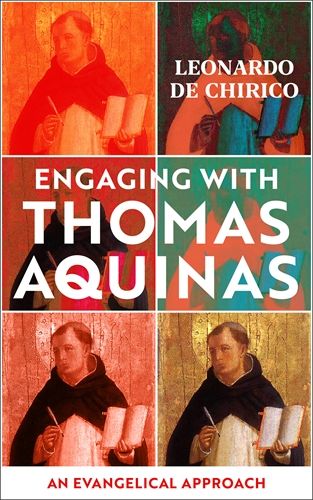
AVAILABLE FOR PRE-ORDER!
On the occasion of the 8th centenary of Thomas Aquinas, the book is a thoughtful introduction aimed at presenting the main contours of his complex legacy and critically evaluating it especially in areas where the “Roman Catholic” Thomas is more than the “classical” theologian who is attracting renewed attention in evangelical circles. IVP Books