109. Jubilee of Mercy (and Indulgences)

June 1st, 2015

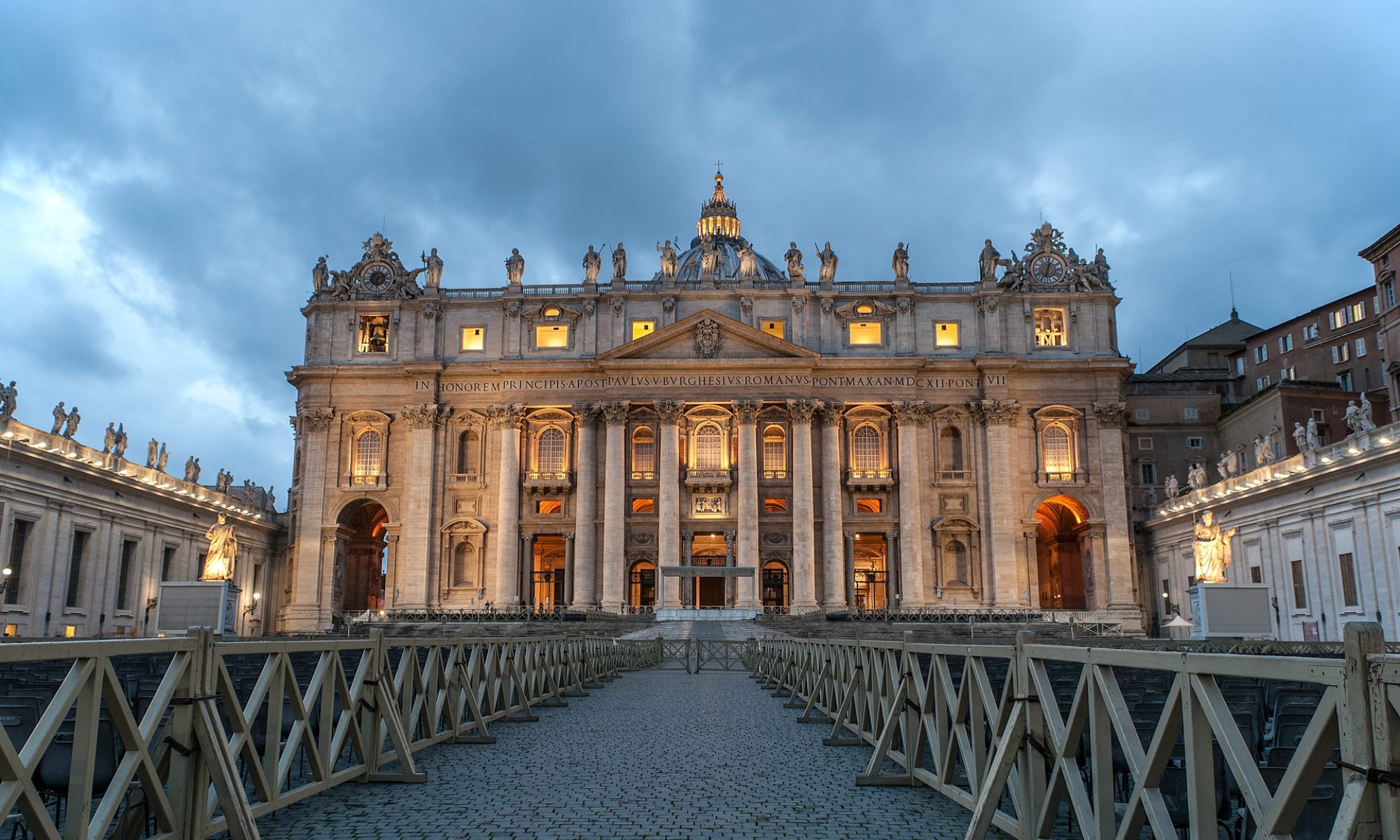
Pope Francis surprised the Catholic community and the public in unexpectedly announcing the indiction of an extraordinary Jubilee year beginning at the end of 2015 and running throughout most of 2016. The tradition of celebrating jubilee years dates back 1300 AD when pope Boniface VIII issued the first holy year calling pilgrims to visit Rome in order to receive a plenary indulgence. The name “jubilee” reminds of the biblical institution of the jubilee whereby, according to the Mosaic law, every fifty years slaves were supposed to be freed and debts had to be cancelled (e.g. Leviticus 25). However, in spite of the name, the Roman ecclesiastical jubilee has little to do with this biblical precedent and mostly to do with the medieval practice of a powerful church granting remission of the penalty of sin by shortening the time in Purgatory. The Vatican jubilee is therefore part and parcel of a theological vision whereby Purgatory is a pillar of the afterlife, the church claims to administer God’s grace on His behalf, and pilgrims have to do some penitential acts like rosaries, pilgrimages, fasting, i.e. religious works, in order to receive the remission. It is not a coincidence that Martin Luther, after visiting Rome in 1511, became troubled with the practice of indulgences and eventually nailed the 95 theses in the (vain) hope that a biblical and public discussion could be initiated.

It is interesting to note that an unconventional Pope like Francis, who is known for his down-to-earth language and easy-going manners, would instead indict a Jubilee year which is part of a long and well-established tradition deeply rooted in the Middle Ages. Even the apparently “fresh” approach by Francis is always to be related to the “old” institution he is head of.

Focus on Mercy

Francis wants his Jubilee year to be focused on mercy. The overall theme of the year and of its wide-ranging activities will be mercy. This is not a new emphasis. His 2013 apostolic exhortation Evangelii Gaudium already centered on mercy as an encompassing rubric of the mission of the church. After being elected, Francis went public in saying that he was reading a book by Cardinal Walter Kasper, Mercy. The Essence of the Gospel and the Key to Christian Life (Mahwah, NJ: Paulist Press, 2014) and that he was profoundly impressed by it. So, the Jubilee of mercy will be a vantage point from which Francis’s understanding of mercy will be displayed in full force.

So far, some indications about how he understands mercy are a mixed bag. In these first two years of his reign, mercy has often been swollen with regard to its biblical meaning as to refer to a sort of divine and universal benevolence towards all. Eye-catching sentences like “Who am I to judge?”, “God forgives who follows his conscience”, “God always forgives”, contribute to widen God’s mercy to the point of being exchanged for an all-embracing, all-inclusive love. Yet unclear is the way in which the Pope relates God’s mercy to His justice and how this relationship fits in the work of Jesus Christ on the cross. According to Scripture, Christ is the “merciful and faithful high priest” who made “propitiation for the sins of the people” (Hebrews 2:17). Any biblical understanding of mercy needs to be interwoven with God’s justice and Christ’s atonement which calls for repentance and faith. Otherwise, mercy can be (ab)used as a general manifestation of kindness which does not depict God’s mercy at all, but is rather a form of humanistic goodwill.

What about Indulgences?

The Bull of indiction of Jubilee of Mercy was issued on April 11th and is entitled Misericordiae Vultus (The Face of Mercy). There was some curiosity about how this outward-looking Pope come “from the ends of the world” would treat a very “Roman” and ecclesiastical topic like indulgences. He deals with it at paragraphs 21-22 where he uses a language much more personal and relational than juridical and traditional, yet the substance of the theology and practice of the indulgences is granted.

In closing, one almost overlapping event will be the V centenary of the Protestant Reformation in 2017. It is interesting to observe that while on the one hand the Roman Catholic Church is officially preparing an “ecumenical” commemoration of the Reformation, on the other she represents and promotes again the theology and the practice that caused the Reformation, i.e. the granting of indulgences. How is it possible to commemorate something that was opposed to the indulgences and, at the same time, focus on the same theological framework that was the cause of the dispute? Is it because the Roman Church is, despite all change, semper eadem, always the same?

Share Button

108. Martin Luther and the Papacy

May 11th, 2015

This is an excerpt from my book A Christian’s Pocket Guide to the Papacy (Fearn: Christian Focus Publications, 2015). Have a look here: bit.ly/1E0JK2j

Luther and the Pope have long been perceived as representing the two enemies within Western Christianity. Their persons embodied the religious conflict that took place in the XVI century giving rise to the Protestant Reformation and the Counter-Reformation. Before Luther rejected the Pope, the Pope had already rejected Luther by condemning him first in 1520 and then excommunicating him in 1521. So it is difficult to establish who first broke fellowship with the other. In fact, before burning the 1520 Papal bull Exsurge Domine that contained his condemnation, Luther was a devout Roman Catholic and highly esteemed the Pope. His acceptance of the Papacy was totally uncritical. He believed that the problem lied with the curia around the Pope, not with the Pope himself. Even after nailing the 95 theses in 1517 he had hopes of finding a hearing with the Pope concerning the need to correct certain moral abuses and doctrinal errors. In the Theses Luther is chiefly concerned with limiting the powers of the Pope, not considering them self-referential and unlimited, but instead under Gospel standards (e.g. Thesis 5). For example, Popes have no power over the souls who are in Purgatory, only God does (Theses 22 and 25). Popes cannot give absolution if God has not granted it (Thesis 6). Popes can only act within the boundaries set by the Word of God.

At this stage, Luther begins to counter the absolute claims of the primacy of the Pope or of the Councils with the primacy of Scripture. In writing against the Catholic theologian Johannes Eck in 1519 Luther develops his critical approach towards the Papacy with a fuller set of arguments (Resolutio Lutherana … de potestate papae). The authority of Popes and Councils should be subordinate to that of the Bible. The Papacy was not instituted by Christ, but was instead established by the Church in the course of its history. So it does not come from “divine law”, but is instead a human institution. The “rock” of Matthew 16 is not a reference to Peter, but is his confession of Jesus on behalf of the whole church or Christ himself. He alone is the solid foundation of the Church. The Roman Popes have nothing “petrine” about them, nor is there anything “Papal” in Peter. The Papacy is not commanded nor foreseen by Scripture, and therefore obedience to the Word of God must take precedence over obedience to the Pope. If the Pope disobeys the Scripture, the faithful Christian should follow the latter without hesitation. Christians are not obligated to obey an unfaithful Pope.

Although the debate was becoming hotter, it was only after his definitive excommunication in 1521 that Luther elaborated his even more radical critique of the Papacy. At this point, Luther became convinced that the supreme adversary of the Christian faith was its supreme representative, i.e. the Pope. The Papacy had become a power structure and could no longer serve the cause of the Gospel, but served instead the carnal interests of the Church. In his response to Ambrogio Caterino (an Italian Dominican monk who had written a defense of the Pope and against what Luther had published on the topic) the German reformer turned his opposition to the Papacy into an apocalyptic argument. In commenting on Daniel 8:23-25, Luther identifies the ferocious king of the passage who devastates the saints as the Pope. Playing with the double meaning of the Greek word anti, Luther argues that the Pope is against Christ and takes his place by claiming to act on his behalf. He is a counterfeit Christ. He is therefore the Antichrist. According to Luther, his times were marked by the imminent end of the world; this then demanded that the situation be painted in black and white. The Pope and the Turks were the representatives of the Antichrist and were focusing their final attack on the Church of Christ.

In 1534 Luther drafted the Smalcald Articles, which are a summary of Christian doctrine from a Lutheran perspective. In art. 4, Luther speaks of the Pope’s power as “false, mischievous, blasphemous, and arrogant” mainly interested in “diabolic affairs”. His critique, however, is not confined to his contemporary experience of the Papacy, but draws on historical and theological arguments. In the same article he writes: “it is manifest that the holy Church has been without the Pope for at least more than five hundred years, and that even to the present day the churches of the Greeks and of many other languages neither have been nor are yet under the Pope. Besides, as often remarked, it is a human figment which is not commanded, and is unnecessary and useless; for the holy Christian [or catholic] Church can exist very well without such a head, and it would certainly have remained better [purer, and its career would have been more prosperous] if such a head had not been raised up by the devil. And the Papacy is also of no use in the Church, because it exercises no Christian office; and therefore it is necessary for the Church to continue and to exist without the Pope”. A church without the Pope captures Luther’s vision at this point.

In 1545, one year before dying, Luther wrote his final fierce thoughts on the Papacy. In his work Against the Papacy at Rome, Founded by the Devil, he is aware that the final, eschatological hour is at hand. The Pope is a child of the Devil who wants to destroy the Church through the sword  of the Turks and through the lies of the Pope. It is an eschatological emergency reaching its final stage. No compromise is possible under these circumstances and evil is to be denounced and fought against relentlessly.

Luther’s views of the Papacy developed over his life from an initial acceptance to a final and total rejection of it. His apocalyptic views served to shed a sinister light on the Pope and shaped his harsh language against him. Yet Luther, the superb Biblical scholar he was, was also an excellent Christian theologian who easily dismantled the superficial Biblical and theological arguments in favor of the Papacy. Because of this rich display of Christian wisdom, his radical criticism cannot be explained in psychological terms as if he were driven by resentment only. His theological assessments set the tone for the wider Reformation movement.

Share Button